We use a Vitamin A derivative, Hydroxypinacolone Retinoate (HPR), that directly activates retinoic acid receptors when topically applied to the skin. This yields the most effective Vitamin A product, without toxicity or sensitization of the skin.
Vitamin A is a general term that refers to fat-soluble compounds found as preformed vitamin A (retinol) in animal products and as provitamin A carotenoids in fruit and vegetables. The three active forms of vitamin A in the body are retinol, retinal, and retinoic acid. Vitamin A is a generic term that encompasses a number of related compounds. Retinol and retinyl esters (an esterified form of retinol) are often referred to as preformed vitamin A. Retinol can be converted by the body to retinal, which can be in turn be oxidized to retinoic acid, the form of vitamin A known to activate receptors and regulate gene transcription. Retinol, retinal, retinoic acid, and related compounds are known as retinoids. β-Carotene and other food carotenoids that can be converted by the body into retinol are referred to as provitamin A carotenoids
While retinal and retinol are used in the photoreceptor visual process, it is retinoic acid that activates the retinoic acid receptors (RAR) to induce the many benefits of Vitamin A products in the skin. Key here is that retinoic acid is what directly binds to the RAR, not retinal or retinol (or their esterified forms). Now, using a form of retinoic acid that is stable and non-irritating, it is Hydroxypinacolone retinoate (esterified retinoic acid) that is used by NeoGenesis in our Vitamin A product to directly activate the retinoic acid receptors (RAR).
For those who are interested, I’ll now do a deeper dive into the Vitamin A story relating to skin care.
Vitamin A, along with other vitamins, minerals and other compounds, is an essential micronutrient. This means that our bodies cannot manufacture it and therefore it has to be included in our diet. It can also be “fed” to the skin when topically applied. There are two main sources of vitamin A: animal sources and plant sources. All the sources of vitamin A, which are fat soluble, need some fat in the diet to aid absorption. In animal sources, vitamin A is found as retinol, the ‘active’ form of vitamin A. Plant sources contain vitamin A in the form of carotenoids which have to be converted during digestion into retinol before the body can use it. Carotenoids are the pigments that help give plants their color, such as in some fruits and vegetables that are red or orange color. Plant sources rich in vitamin A include: mangos, papaya, many of the squashes, carrots, sweet potatoes, green leafy vegetables, and maize (but not so much the white varieties).
Vitamin A is essential for many physiological processes, including maintaining the integrity and function of all surface tissues (epithelia): for example, the skin, the lining of the respiratory tract, the gut, the bladder, the inner ear and the eye. Vitamin A supports the daily replacement of skin cells and ensures that tissues such as the conjunctiva (the white tissue of the outer eye) are able to produce mucous and provide a barrier to infection. Vitamin A is also essential for vision, for maintaining a healthy immune system, for growth and development, and for reproduction. Vitamin A supports many physiological processes in the body. For this reason, vitamin A deficiency is now referred to as vitamin A deficiency disorders.
Vitamin A (VA) and its derivatives are of interest in the skin care drug and cosmetic industries because they act as antioxidants and cell regulators, thereby improving skin texture by stimulating collagen production and reducing skin damage.
The vitamin A pathways are complex, so, first, let’s be clear on some relevant terms. The noun “retinoid” refers to the family of ingredients derived from vitamin A and includes tretinoin, retinyl palmitate, retinol, retinaldehyde, and hydroxypinacolone retinoate (HPR). Notice we use the term “retinoid” and not the erroneous term “retinols”, a term frequently misused in the mass media. Thus, there are many retinoids, of which retinol (also known as Vitamin A1) is one type.
To be clear, the term “retinoid” refers to the synthetic and natural analogues of vitamin A. Retinoids are a class of compounds derived from vitamin A or exhibiting structural and/or functional similarities to vitamin A. Thus, retinoids are molecules that can bind to and activate the appropriate nuclear retinoic acid receptors (RAR) to induce transcription (activation of genes) of relevant DNA sequences (genes) either by binding directly to the RAR or after metabolic transformation that allows the retinoid to bind to the RAR.
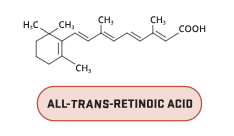
Retinol (vitamin A) itself doesn’t directly bind to retinoic acid receptors (RARs). Retinol needs to undergo conversion to retinoic acid (tretinoin) first. This conversion process happens inside cells by enzymes. Once converted, retinoic acid then binds to RARs. Tretinoin (see Figure below), also known as all-trans retinoic acid (ATRA), is well known for its antiaging effects on skin. However, skin irritation, photochemical instability, and concerns about toxicity have hindered the use of ATRA in cosmetic products and limited its availability as a carefully controlled prescription drug. Typically, milder retinoid derivatives are used in cosmetic products, which must first be metabolized to more active forms by several enzymatic steps in the skin, reducing their potency. Therefore, new molecules have been discovered that activate retinoic acid pathways directly without being enzymatically (for example, Retinol dehydrogenase), processed by the body, and without the negative side-effects.
Hydroxypinacolone retinoate (HPR; see Figure below) is a cosmetic grade ester of ATRA. Retinoate is the scientific term for an esterified form of retinoic acid. HPR is unique among non-retinoic acid retinoids because it processes innate retinoic acid activity, binding directly with retinoid receptors without the need for metabolic breakdown to more biologically active forms. It has been demonstrated to be more stable and cause less skin irritation than retinol.

Hydroxypinacolone retinoate (HPR) is part of a new generation of anti-aging ingredients in the retinoic acid family, which have unique properties. Unlike other derivatives, HPR can act directly without being converted to retinoic acid, a compound that can irritate the skin. HPR can be safely applied around the eyes with better skin penetration and higher stability. A study by Counts et al found that topical application of RP (similar to HPR) in rats for 14 days resulted in epidermal thickening and enhanced protein and collagen stimulation. In another comparative study, an increase in epidermal thickness was also observed in human skin.
The exact mechanisms by which topical tretinoin and other retinoids function are not completely understood, but current evidence suggests mediation through binding of retinoic acid receptors (RARs) alpha, beta, and gamma along with retinoid X receptors (RXRs) by blocking inflammatory mediators. Through this action, the production of procollagen increases to augment collagen type I and III formations.
Recent studies have found that HPR (Hydroxypinacolone retinoate) had greater levels of gene transcription than other cosmetic grade retinoids (Rol, Ral, and RP) at the same concentrations, and was less cytotoxic to cells at a 10 times higher concentration. HPR was nearly as effective as prescription ATRA when measuring increased gene transcription levels. Measures of procollagen concentration levels found that skin treated with HPR significantly increased procollagen production compared with untreated control skins, and was similar to ATRA. Qualitative assessment of collagen levels from histologic staining of skin corroborated those results, with the highest dose of HPR out-performing ATRA. IL-1α ELISA analysis (a means to measure the levels of this pro-inflammatory cytokine) showed that HPR did not induce more (or less) inflammatory response than either ATRA or the vehicle control. These data provide evidence that Hydroxypinacolone retinoate (HPR) is an effective alternative to ATRA and other less potent retinoids in the treatment of aging skin without the negative side-effects.
Clinical testing of our new HPR product has found it to be safe, non-irritating, and to be synergistic with our S2RM technology. Stay tuned for the release of our new product.
 Dr. Greg Maguire's Skin Care