Chemicals in Sunscreen can Penetrate The Skin and Become Systemic: Choose Your Sunscreen Carefully. Toxic chemicals, such as PFAS and Benzene have been found in certain sunscreen products
Chemical Sunscreens vs. Mineral Sunscreens
Sunscreens are important to keep the skin safe from exposure to damaging UV irradiation, something that increases the odds of skin cancer. Sunscreen use has been found to reduce the risk of melanoma. The most aggressive form of skin cancer is melanoma, arising when pigment-producing skin cells, called melanocytes, become cancerous in a state of uncontrolled proliferation. Melanoma is becoming more common every year. While people with dark skin are less likely to have melanoma, if they do develop melanoma their outcomes will be worse than those with lighter skin. Studies have found that exposure to ultraviolet (UV) radiation from the sun increases your risk of melanoma, especially if you had sunburns during childhood. Melanoma is distinct from non-melanoma skin cancers in that it tends to spread locally, regionally, and distantly. Once melanoma cells are formed in the skin, the melanoma cells send out messages that change the surrounding lymph tissue such that the lymph becomes more permissible to the spread of the melanoma cells to other parts of the body. An individual’s risk of metastasis (spread of the cancer) is directly related to the depth of invasion and ulceration of their primary lesion. This alone is why sunscreens are so important.
UV irradiation also causes oxidative damage in cells due to the release of inflammatory cytokines that in turn generate reactive oxygen species (ROS), damaging lipids, proteins and DNA. Premature aging of the skin results, with coincident inflammation. To keep the skin safe, reapplying sunscreen is recommended every 2 hours when out in the sun. This means that sunscreen stays in contact with skin over a long period of time. When products are applied to the skin, especially so-called leave-on products, your skin has long term exposure to the ingredients in the product. Many of the ingredients can absorb into the skin, and some of the ingredients may have negative effects. Careful choice of a product based on its ingredients is therefore critical to your health.
A recent report from the Environmental Working Group (EWG), a non-profit in the US, found that only 25 percent of the 1,700 SPF products reviewed offer good broad-spectrum protection without troubling ingredients. Many of the products don’t effectively block the damaging UV incident on the skin, and many contain ingredients that are harmful, such as oxybenzone (aka benzophenone-3). This ingredient is known as a chemical sunscreen as opposed to a physical block sunscreen. Mineral sunscreens, which are physical block sunscreens that absorb UV, are composed of the minerals zinc oxide and titanium dioxide. I use these two ingredients when formulating sunscreens for NeoGenesis because the zinc component blocks UVA and the titanium blocks UVB. Longer wavelength UVA penetrates deeply into the dermis. In contrast, UVB is almost completely absorbed by the epidermis, with comparatively little reaching the dermis. UVA is efficient at generating reactive oxygen species that can damage DNA via indirect photosensitizing reactions. UVB is directly absorbed by DNA which causes molecular rearrangements forming the specific photoproducts such as cyclobutane dimers and 6–4 photoproducts. Mutations and cancer can result from many of these modifications to DNA. The mineral sunscreens use small particles that sit on the skin’s surface and physically block and scatter only a small portion of the incident UV, but absorb most of the UV, keeping the UV rays from penetrating the skin. Chemical sunscreens work differently, allowing UV radiation into the skin. Once the UV is absorbed into the skin, the chemicals in the sunscreen, such as oxybenzone, avobenzone, octisalate, octocrylene, homosalate, and octinoxate, create a chemical reaction in which UV radiation is converted to heat, and the heat dissipates from the skin.
In 1997, a study in the Lancet found that substantial amounts of an applied sunscreen, oxybenzone, were absorbed and subsequently excreted in human urine. Although oxybenzone has low acute toxicity in animal studies, little is known about its chronic toxicity and disposition after topical application in people. A small randomized clinical trial published in May 2019 in the Journal of the American Medical Association (JAMA) found that four of the chemical sunscreens (avobenzone, oxybenzone, octocrylene, and ecamsule) were absorbed into the bloodstream at significantly greater levels than 0.5 nanograms per milliliter (ng/mL). That level of these chemicals is far above the amount at which the FDA requires topical medications that also use these chemicals to undergo safety studies to determine possible toxic effects. In other words, FDA approved drugs are being more carefully monitored for these toxic ingredients than are sunscreens.
Physicians will take a reductionist view of these data and say that the exposure to one of these ingredients is not harmful. They fail to understand that it is the totality of your exposures that will be harmful. We are bombarded with thousands of chemicals daily. The combination of chemical exposures is not understood. What is understood, very well, is that the increased exposure to chemical is leading to the rapid rise of diseases, and our exposome accounts for about 90% of all diseases. The popular media in addition to the medical journals, fails to understand their own reductionist mindset. Understand that the FDA is overworked and underfunded, and sometimes suffers from regulatory capture by corporations because we fail to pass laws that limit corporate money from influencing laws and regulations, such that unless a product is found to kill or maim you quickly, said product may not be properly regulated for many years. Only through the accumulation of observational data in the general population will most of the ill effects of a chemical be discovered. This is true for FDA approved drugs. Consider, many poor drugs go to market following biased, randomized, placebo controlled clinical studies and are then pulled from the market because observational studies in the general population find that they are unsafe. These are real-world observational studies, not highly controlled clinical studies designed with a bias to attain a FDA approval. These are so called Phase 4 observational studies. The real-world observational studies of a particular chemical do so in a large group of people, more representative of the general population than a clinical trial, doing so for a longer period of time than a clinical trial. The real world studies are also done in people with normal exposure to other chemicals so better reflect a combination of exposures than do the clinical trials. How many times have I heard that “randomized control trials, considered the gold standard in research” are the way to understand something. This is absolute bullshit. Most of what we know about the universe, whether it is physics, chemistry, or biology is through observational studies. This is also true of FDA approved drugs. Most all of the preclinical research is observational, many of the clinical trials are observational, not controlled trials, and as I said, most of the Phase 4 studies that cause many drugs to be pulled from the market or relabeled, are observational. Sadly, many drug companies hide their safety data because it is damning for their drug. But using careful observation by those who don’t have conflicts of interest, much can be learned.
Further, if you want to understand why observation is key to understanding everything, read the book by UCLA professor, Dr. Judah Pearl, Ph.D., “The Book of Why.” Here you can learn why the phrase “Correlation is not causation” is bullshit. This mantra, chanted by physicians for more than a century, has led to a virtual prohibition on causal talk. Today, that taboo is dead. The causal revolution, instigated by Dr. Pearl and his colleagues, has cut through a century of confusion and established causality — the study of cause and effect — on a firm scientific basis. If you observe the rooster crowing and the sun rising, finding that they are strongly correlated, you can understand that the rooster does not cause the sun to rise by simple observation. The simple observational, not a randomized, placebo controlled clinical trial, is to shine artificial light on the rooster and observe that artificial light will stimulate a rooster’s crowing and the sun will fail to rise. DAH!
The chemical sunscreens are also damaging to marine life, including our beautiful and life sustaining reefs, including the coral Galaxea fascicularis, and have been banned for use in jurisdictions such as Hawaii (first in nation) and Key West, FL. However, Ron DeSantis and the Florida Legislature passed a bill to block Key West’s ban on chemical sunscreens. The beautiful, once protected reefs around the Keys that I dived as child growing-up in Miami continue to die. The protection began in 1960 under the progressive leadership of Republican President Dwight D. Eisenhower and Democratic Governor LeRoy Collins. Protection dies under regressive policies. As with sunscreen and drug exposures in humans, sunscreen exposure to marine life is only one of many toxic chemical exposures that may be killing our coral reefs. The National Academy of Sciences discusses it here, and their headline is: “Without a doubt, a variety of compounds present in the mixture of chemical pollution entering our environments are a contributing cause of ecological decline.” Let us please stop our reductionist thoughts on these chemical exposure problems – “it’s the combination, stupid.”
Sun care products that use physical sunscreens instead of chemical sunscreens limit exposure to ingredients such as avobenzone are also the better choice because the chemical sunscreen ingredients cause allergic skin reactions , behave like a hormone disruptor in many studies, and may cause more harm to children. Look for products that contain the physical UV blockers such as the minerals titanium dioxide and zinc oxide in a non-spray format. When in an aerosol spray, the product may also contain benzene, a powerful carcinogen and hematotoxin.
PFAS (Forever Chemicals)
PFAS, a long lasting chemical found in many sunscreens has been banned in cosmetics by California (first in nation). PFAS do not naturally exit the body for many months or many years and are not known to degrade in the environment, they are considered “forever chemicals.” Widespread human exposure to PFAS in water, food, and air coupled with the lengthy environmental persistence and biological half-lives of months to years for some PFAS have led to measurable PFAS in the blood of nearly the entire population in developed countries, with health effects reported globally. While much work has provided evidence that these PFAS chemicals are damaging, more studies are required to better understand what can be done to mitigate their effects, especially given they remain in our environment for decades. Therefore, it’s imperative to reduce the amount of PFAS you are exposed to by food, water, and topical care products. Some of the damaging effects on the human body are illustrated in Figure 1. Be aware that the damaging effects may be more severe in children given their brain, immune system, and other organs are developing in a rapid manner where toxic chemicals may interfere with developmental signaling molecules in the child’s organs.
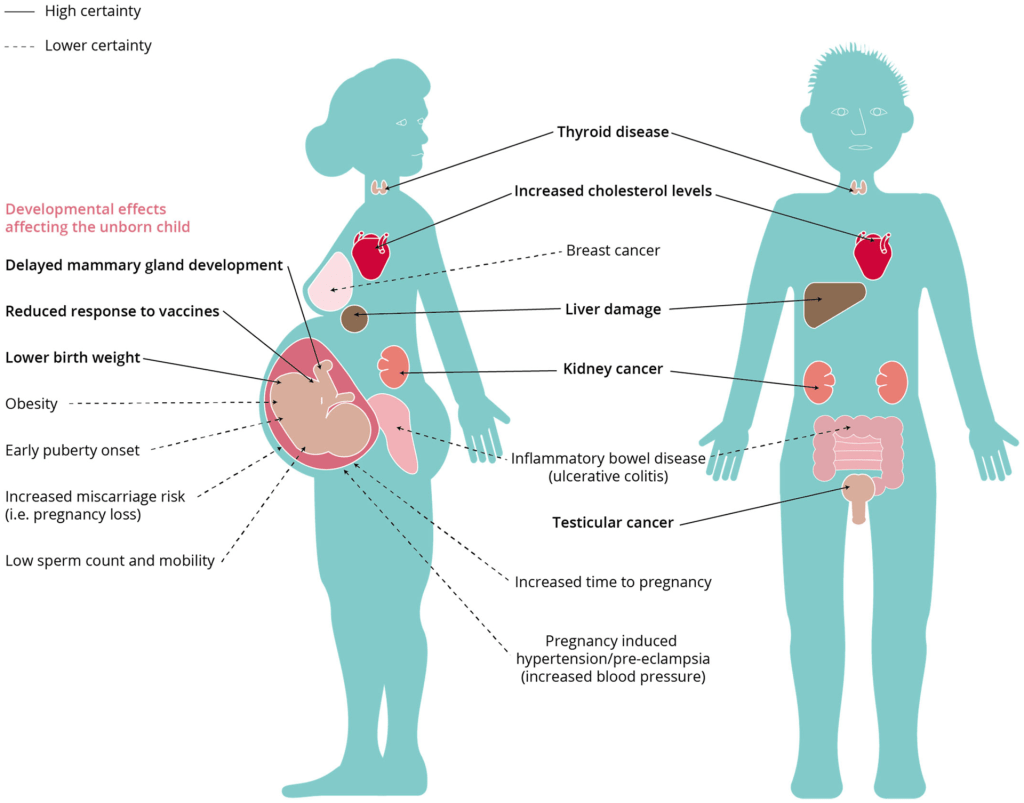
Figure 1. Effects of per- and polyfluoroalkyl substances on human health. Used with permission from European Environment Agency (2019).
I’ve recently co-formulated a physical block sunscreen that has a completely safe and effective set of ingredients for NeoGenesis. Our product has no chemical sunscreen ingredients, no benzene, not an aerosol or spray, and no PFAS. Nothing but EWG approved ingredients. We’re currently finishing our testing and going through the approval process for bringing it to market. We’ll be launching our product soon. Stay tuned.
 Dr. Greg Maguire's Skin Care