It’s the Skin’s Architecture, Not So Much its DNA, That Causes Skin Cancer

DNA mutations in normal skin occur at high rates without cancerous growth. But when the skin’s architecture is broken down, those mutations can lead to cancer. Maintaing the skin’s architecture is critical to skin health.

Mutations Are Everywhere, But Cancer Isn’t

Scientists have looked at UV-exposed eyelid skin of middle-aged adults, and found that a square inch of normal, non-cancerous skin was riddled with mutations, many of them considered cancer drivers. The number of mutations in normal skin tissue rivaled the number seen in skin tumors, and exceeded the number of mutations seen in other tumor types, like breast cancer. Such findings once again set researchers’ expectations about how powerfully these mutations could promote cancer. There’s more to cancer than just mutations in our cells.

It’s The Architecture Stupid, Not the DNA

Prof. Dr. Cyrus Ghajar, Ph.D., a scientist at Fred Hutchinson Cancer Center, has noted that cancer-driving mutations are defined using animal studies. After identifying what is thought to be a common cancer-associated mutation in human cancers, researchers introduce the mutations into mice to see if tumors arise. If they do, they’re considered cancer drivers. But when you find these mutations in people in normal tissue, then what does that mean? It’s clearly not a driver.  Mutations, it turns out, needs partners to drive cancer. They need another powerful mutation and an abnormal microenviornment, to induce cells toward cancerous growth.

The mutation-riddled reality of normal skin tissue prompts us to realize that skin has ways of handling mutations and keeping cellular growth normal. As Prof. Dr. Mina Bissell, Ph.D. at Berkeley has taught us, our organs are set up for function, and that function is inextricably linked to chemical envionment of the cells and the architecture into which the cells are embedded. Most cells in an organ are differentiated, meaning they perform a specialized function. And this differentiated state isn’t merely governed by an internal molecular decision-making process within each cell. It’s a collective process, a top-down process, where the architecture dictates function. If a cancer cell wanders into another organ and survives, it falls under the spell of the architecture, the top-down process instructing the cancer cell to renormalize. Dr. Bissell taught us this many years ago. As shes says, “to understand cancer it is important to understand that the phenotype can override the genotype.” Further, “influences such as what you eat, your internal metabolism, inflammation and the sun’s rays” affect your phenotype and hence your genotype. For example, in the aforementioned study of eyelids, the sun is causing mutations, but the phenotype, the cellular chemistry and architecture, has overridden the genotype, the mutated DNA, and the cells are behaving normally without cancerous growth.

Cancer Reverts if Normal Architecture is Restored

Dr. Bissell and team, in a landmark study, found that if they took breast cancer cells and put them back into a normal microenvionment, a normal architecture, then the cancer cells reverted back to normal. Their results demonstrated that the extracellular matrix, i.e the architecture and its inherent chemistry, dictate the phenotype of mammary epithelial cells, and thus in the model system tested, the tissue phenotype was dominant over the cellular genotype.

A Glimpse at the Big Picture of DNA, Cells, Architecture and Downward Causation

In the big picture, what I’m talking about is downward causation. The architecture instructs the pieces what to do. So the cellular structure is instructing what the DNA, all of the DNA, needs to do. That’s downward causation. We inherit downward causation because life derives from the cell. Cells make cells. Put DNA in a dish, it sits there, inert. Put DNA into a cell, it will begin to function, with that function dependent on what cell it is in. The cell, of course, has architecture, and it is the cell’s architecture that sets boundary conditions, instructing the molecules in the cell, including the molecules in the DNA, what they should do. We humans arise from cells, the mother’s egg – and that egg receives architectural signaling from the fathers sperm, which delivers DNA contained in it own architecture, the centriole. In other words, that cellular architecture and that of it’s surroundings, is critical to the cell’s function, to creating life, and whether cells will become cancerous. Along with Dr. Mina Bissell, Prof. Dr. Dennis Nobel, Ph.D., at Oxford, has been a pioneer in this way of thinking.

Sun Exposure Can Damage the Architecture, Not Just DNA

Concerning sun exposure and skin cancer, what happens when UV damages the skin? Is DNA damaged? Yes. But damaged too is the architecture, incuding the constiuent proteins and lipids in the architecture. As Drs. Bissell and Ghajar have taught us, it’s the cells surrounding architecture that will determine whether a cell becomes cancerous. So the UV damage of the proteins and lipids that make the architecture of the skin will be critical to determing whether the skin is cancerous or normal.

What to Do to Protect the Skin’s Architecture

What do you need to do for your skin to be healthy and free from cancer? Normalize the architecture of the skin. How do you do this? 1. First, dose your skin with sunlight in moderation to protect the skin’s architecture. If you’re out for long, wear a sunblock. 2. Eat well. Fruits and vegetables contain many of the nutrients to needed to maintain and regenerate the skin’s architecture. 3. You can also utilyze a skin care routine that maintains and regenerates the skin’s architecture. Using a combination of NeoGenesis Recovery and Barrier Renewal Cream, for example, will help to maintain and regenerate the architecture of the dermis and epidermis. NeoGenesis Recovery will also help to optimize the skin’s natural ability to repair DNA. Also available are retinoid products and antioxidant skin care products that can also help to prevent damage and rebuild the skin’s architecture.
DNA Damage Repair: Animals Do It Better Than Plants and Microorganisms

Although plants and microorganisms such as algae possess some of the DNA damage response factors that are present in animal systems, they are missing many of the important regulators, such as the p53 tumor suppressor. The p53 mechanism halts the cell cycle when DNA damage is detected, giving repair machineries time to act. These observations point to the differences in the DNA damage response mechanisms between plants and animals. While DNA repair enzymes from plants may help the skin when topically applied, optimizing the DNA repair mechanisms inherent in animals is the optimal strategy for repairing DNA in animals. Adipose mesenchymal stem cell released molecules (secretome) help to optimize inherent DNA repair mechanisms when topically applied to the skin, including heat shock proteins. More importantly, the molecules help to rebuild the architecture of the skin, which prevents mutations from forming cancerous cells (see my Blog on this topic).

All plant extract contain DNA repair enzymes

If you’re using a product with plant extract, you’re likely using DNA repair enzymes. All, or nearly all, plants contain DNA repair enzymes. Keep in mind, this is important, an intrinsic feature of plant and microorganism DNA repair pathways is that they are not error-free, leading to potentially transmissible mutational alterations. The error-prone nature of some DNA repair mechanisms, however, increases the genetic diversity and variability of the populations, thus contributing to the evolution of plant genomes. In other words, despite the recent hype about DNA repair enzymes in plants/microorganisms, they don’t work well and are “error prone.”

Animals have more robust DNA reair enzymes than do plants

This is not true in animals. They are not error prone. Because animals must better protect their DNA than do plants to prevent and repair mutations that are harmeful, potentially lethal. This is why stem cells in the skin faciltate DNA repair as only animals can do.

Stem cells in the skin have the most robust DNA repair mechanisms

As stated in a presitigious scientific journal, Molecular Cell, ” adult stem cells are endowed with a superior capacity to prevent the accumulation of genetic lesions, repair them, or avoid their propagation to daughter cells, which would be particularly detrimental to the whole organism.” Further stated, “SCs [stem cells] count upon robust antioxidant defenses (which limit genotoxicity) and a superior DDR (to repair unavoidable damage). These mechanisms are in place to protect cellular homeostasis.” 

DNA repair mechanisms: it’s complicated and very efficient if enabled

DNA double strand breaks (DSBs) are a serious threat to genome stability and the erroneous repair of DNA may lead to chromosomal rearrangements with potentially lethal consequences, including cancer, for an organism. The response to DSBs elicits a highly complex and organized cellular program, called the DNA damage response (DDR), setting in motion processes that mitigate the adverse effects of DNA damage and facilitate DNA repair. Broken DNA is usually repaired by two mechanistically distinct pathways: homologous recombination (HR) and non-homologous end joining (NHEJ). HR is a complex, multistep process that allows large sections of DNA to move from one chromosome to another. NHEJ is a DNA repair mechanism that fuses broken DNA ends together without the need for a homologous template While HR uses a homologous DNA strand as a template for error-free repair, NHEJ is inherently error-prone and does not rely on sequence homology. The preferred mode of repair and cellular consequences of DDR varies between organisms and is also dependant on cell type and cell cycle context. For example, while HR is the preferred mode of repair in many unicellular organisms such as budding and fission yeast, NHEJ is the prevalent pathway in plants and animals.

Plants versus animals, digging deeper into the mechanisms

However, in many aspects, plants respond differently to DNA insults than do animals. The constant risk of tumor formation in animals has led to evolution of DDR that assures precise genome maintenance, often resulting in apoptotic death of significantly damaged cells. The lack of such a strong selective constraint presumably permitted evolution of a less potent DDR in plants, making plants more prone to genome damage. Furthermore, plant cells are exposed to high levels of genotoxic stress resulting from long-term exposure to solar ultraviolet (UV) irradiation, photosynthesis and extended periods of desiccation. Thus, some features of plant DDR and DSB repair may deviate from models primarily established from studies in yeasts and mammals.

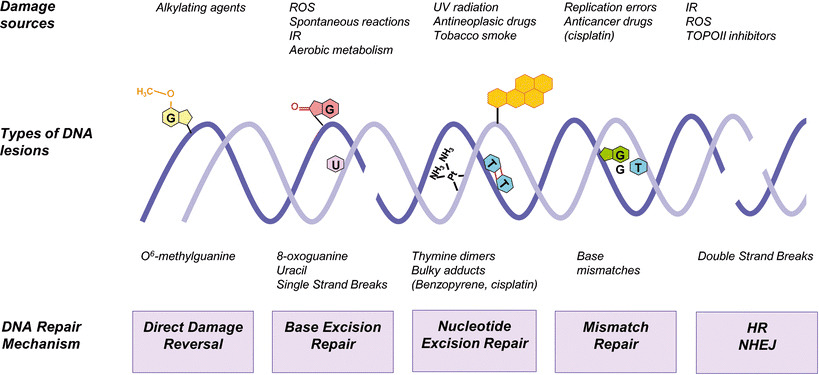
DNA repair in animals is even more complicated than that described by the two major pathways. Five DNA repair mechanisms are usually distinguished: (a) direct DNA damage reversal, (b) BER, (c) mismatch repair (MMR), (d) nucleotide excision repair (NER), and (e) homologous recombination (HR) and non-homologous end joining (NHEJ). DNA repair pathways were originally restricted to the nuclear compartment. Ample evidence indicates that mitochondria possess a number of DNA repair factors and mechanisms shared with the nuclear processes.

From: Sottile and Nadin (2018). Sources of DNA damage and repair mechanisms. Endogenous and exogenous agents constantly impact on DNA. They may cause many different forms of DNA damage. The scheme shows the five major DNA repair mechanisms operating in the nucleus of mammalian cells capable of removing a wide range of DNA lesions: direct damage reversal, base excision repair (BER), nucleotide excision repair (NER), mismatch repair (MMR), homologous recombination (HR), and non-homologous end joining (NHEJ). The BER system may also be found in the mitochondria. ROS reactive oxygen species, IR ionizing radiation, TOPOII topoisomerase II

Not included in the above summary is a new form of DNA repair in animals, called neucleophagy. This was just reported in October 2024 by a group of scientists at Oxford. Found to be evolutionarily conserved and clinically relevant, we’ll know more baout this mechanism in the coming years. Its mediated by TEX264, an intrinsically disordered protein, and as such, I suspect this will be an important and widespread DNA repair mechanism, possibly involving adult stem cells and their secretome – stay tuned.

How adult adipose mesenchymal stem cell scretome faciltates DNA repair

These complicated processes are faciltated by a number of molecules, including proteins, such as heat shock proteins, released by adipose mesenchymal stem cells (ADSCs). Another example, ADSCs release sirtuins, which are involved in DNA repair. The sirtuins work both as protein activators and chromatin-structure-modifying enzymes. Deacetylation carried by sirtuins represents a basic epigenetic mechanism. Histone modifications including deacetylation and poly-(ADP)-ribosylation compromise an essential part of physiological ageing processes that are involved in the pathogenesis of ageing-related diseases. Stem cells are also known to produce 5-hydroxymethylcytosine binding, embryonic stem-cell-specific (HMCES) protein functions as an intermediate in DNA interstrand cross-link repair, part of BER. Antioxidants from ADSCs are also important for DNA repair. They include: Superoxide dismutase (SOD): This enzyme converts superoxide radicals (O2-) into hydrogen peroxide (H2O2), which is then further broken down by other enzymes like catalase. Catalase (CAT): Catalase directly breaks down hydrogen peroxide (H2O2) into water and oxygen, preventing further oxidative damage to cellular components including DNA.  Peroxiredoxins (Prxs): This family of enzymes also plays a significant role in scavenging reactive oxygen species, particularly in the nucleus where DNA is located, and can directly contribute to DNA repair mechanisms.

The secretome from ADSCs was tested for skin repair following irradiation, where DNA and protein damage is a key component in the radiation dermatitis. Working with Dr, Michael Traub, N.D., NeoGeneis found that simple topical application of ADSC secretome in its Recovery product significantly reduced radiation dermatitis. The Recovery works through the many types of molecules found in the ADSC (and fibroblast) secretome that enable the skin’s robust DNA repair mechanisms to work optimally.

Beyond the hype of plant/microorganism DNA repair enzymes

You can see that using the secretome from ADSCs is much more powerful than using a plant or microorganism extract to repair DNA. While DNA repair enzymes from plants and microorganisms have been found to reduce cyclobutane pyrimidine dimers, and presumably repair DNA in humans when compared to doing nothing, the “DNA repair” products on the market contain many other ingredients that are at least partially responsible for their efficacy. Those other ingredients include antioxidants and sunblocks. If you want a great topical product to repair DNA in your skin cells, use NeoGenesis Recovery that is full of the molecules released from ADSCs, including those molecules in exosomes and those molecules in the soluble fraction.