Mechanisms Of Action of NeoGenesis Hair Thickening Serum

Topical application of Hair Thickening Serum (HTS) promotes hair growth by two key means: Providing, 1. Skin and hair follicle endogenous molecules from skin and hair follicle stem cells (Adipose mesenchymal stem cells, fibroblasts, and dermal papillae) that drive and maintain the transition from telogen to anagen, and 2. Botanical ingredients normally derived from healthy diets that support hair growth.
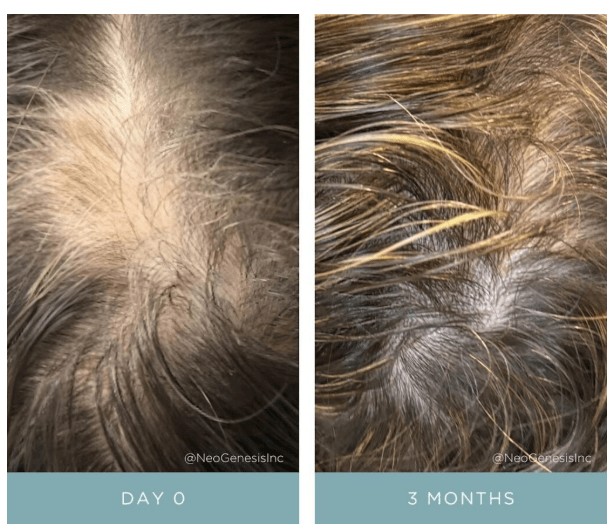
Simple topical application of NeoGenesis Hair Thickening Serum, b.i.d., twice daily.

Let’s look at the hair growth cycle, and some of the many factors affecting hair growth. I’ll then explain some the mechanisms by which HTS drives the hair follicle to the anagen phase.
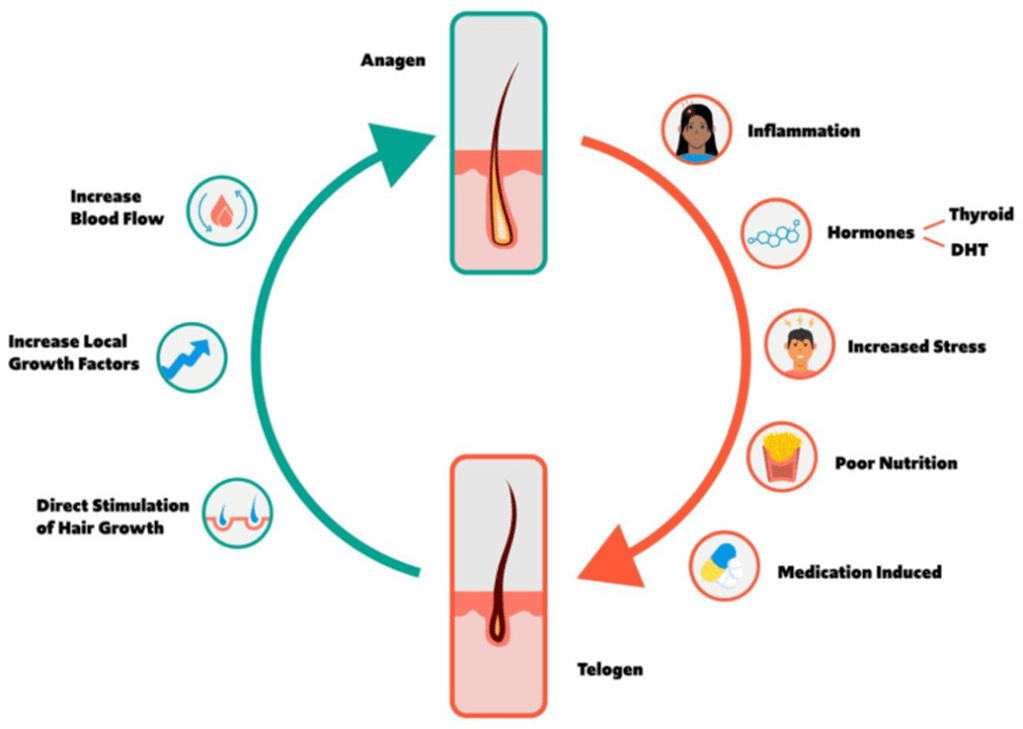
Figure 1. Schematic of the hair growth cycle and the factors that may influence a transition from anagen to telogen vs. telogen to anagen phase. From Natarelli et al, 2023.

HTS Mechanisms of Action in the Hair Growth Cycle

HTS’ mechanisms of action at the hair follicle are many. Here I consider a simplified summary of some of the pathways that the stem cell released molecules and botanical ingredients activate or inhibit to drive and maintain the follicle’s transition to the anagen phase.

Transition from Anagen to Telogen

Inflammation – An immunoprivileged state in the follicle is needed to drive anagen, and inflammation transitions the follicle to telogen instead (Bertolini et al, 2020). HTS reduces inflammation in the innate and adaptive immune systems by using the secretome from adipose mesenchymal stem cells – both the exosomal fraction and soluble fractions that act synergistically to optimally reduce inflammation (González-Cubero et al, 2022; Mitchell et al, 2019)

Hormone – ADSC secretome inhibits negative effects of DHT on hair growth (Tang et al, 2023; Fu et al, 2025).

Poor Nutrition – HTS contains nutrients to support hair growth. Larix Europaea Wood Extract, containing Dihydroquercetin-glucoside (polyphenol), EGCG (polyphenol catechin), glycine, zinc, Camellia Sinensis Leaf Extract, Santalum Acuminatum Fruit Extract, Citrus Glauca Fruit Extract, Acacia Victoriae Fruit Extract, Trifolium Pratense (Clover) Flower Extract (providing an abundance of polyphenols and antioxidants).

Stress – ADSC secretome mitigates immunological disturbances affecting the hair follicle (HF) and contributing to hair loss. ADSCs are able to suppress lymphocyte proliferation and, inhibit complement activation and dendritic cell differentiation from monocytes and therefore are considered natural immunosuppressants (Salhab et al, 2022).

Transition from Telogen to Anagen

Blood Flow – Secretome of ADSCs promotes angiogenesis and increased blood flow to follicles (Silveira et al, 2022; Zhu et al, 2020)

Direct stimulation of Hair Growth – Exosomes from dermal papillae cells drive hair follicle stem cell proliferation to rebuild hair follicle (Li et al, 2023), while fibroblasts provide many building-block proteins need to reconstruct the follicle architecture as it transitions from telogen to anagen (Suh et al, 2023).

Increased Local Growth factors – Fibroblasts (Lin et al, 2015), ADSCs (Won et al, 2017), and dermal papillae (HU et al, 2020) secretome all provide necessary growth factors to induce transition to anagen

References

Bertolini M et al (2020) Hair follicle immune privilege and its collapse in alopecia areata. Exp Dermatol. 29: 703–725.

Fu Y, Han YT, Xie JL, Liu RQ, Zhao B, Zhang XL, Zhang J, Zhang J. Mesenchymal stem cell exosomes enhance the development of hair follicle to ameliorate androgenetic alopecia. World J Stem Cells 2025; 17(3): 102088

Fu Y, Han YT, Xie JL, Liu RQ, Zhao B, Zhang XL, Zhang J, Zhang J. Mesenchymal stem cell exosomes enhance the development of hair follicle to ameliorate androgenetic alopecia. World J Stem Cells 2025; 17(3): 102088 [PMID: 40160691 DOI: 10.4252/wjsc.v17.i3.102088]

González-Cubero, E et al (2022) María L. González-Fernández, Elias R. Olivera, Vega Villar-Suárez,Extracellular vesicle and soluble fractions of adipose tissue-derived mesenchymal stem cells secretome induce inflammatory cytokines modulation in an in vitro model of discogenic pain,The Spine Journal,Volume 22, Issue 7,2022, Pages 1222-1234

Li J, Zhao B, Yao S, Dai Y, Zhang X, Yang N, Bao Z, Cai J, Chen Y, Wu X. Dermal PapillaCell-Derived Exosomes Regulate Hair Follicle Stem Cell Proliferation via LEF1. Int J Mol Sci. 2023 Feb 16;24(4):3961.

Lin WH, Xiang LJ, Shi HX, Zhang J, Jiang LP, Cai PT, Lin ZL, Lin BB, Huang Y, Zhang HL, Fu XB, Guo DJ, Li XK, Wang XJ, Xiao J. Fibroblast growth factors stimulate hair growth through β-catenin and Shh expression in C57BL/6 mice. Biomed Res Int. 2015;2015:730139.

Mitchell R et al (2019) Secretome of adipose-derived mesenchymal stem cells promotes skeletal muscle regeneration through synergistic action of extracellular vesicle cargo and soluble proteins. Stem Cell Res Ther. 10(1):116.

Natarelli N, Gahoonia N, Sivamani RK (2023) Integrative and Mechanistic Approach to the Hair Growth Cycle and Hair Loss. J Clin Med. 2023 Jan 23;12(3):893.

Salhab O, Khayat L, Alaaeddine N (2022) Stem cell secretome as a mechanism for restoring hair loss due to stress, particularly alopecia areata: narrative review. J Biomed Sci. 2022 Oct 5;29(1):77.

Shiqi Hu et al. (2020) Dermal exosomes containing miR-218-5p promote hair regeneration by regulating β-catenin signaling.Sci. Adv.6,eaba1685(2020).

Silveira BM, Ribeiro TO, Freitas RS, Carreira ACO, Gonçalves MS, Sogayar M, et al. (2022) Secretome from human adipose-derived mesenchymal stem cells promotes blood vessel formation and pericyte coverage in experimental skin repair. PLoS ONE 17(12): e0277863.

Suh SB, Ahn KJ, Kim EJ, Suh JY, Cho SB. (2023) Proteomic Identification and Quantification of Secretory Proteins in Human Dermal Fibroblast-Conditioned Medium for Wound Repair and Hair Regeneration. Clin Cosmet Investig Dermatol. 2023;16:1145-1157

Tang, Xin, Cao, Cuixiang, Liang, Yunxiao, Han, Le, Tu, Bin, Yu, Miao, Wan, Miaojian, Adipose-Derived Stem Cell Exosomes Antagonize the Inhibitory Effect of Dihydrotestosterone on Hair Follicle Growth by Activating Wnt/β-Catenin Pathway, Stem Cells International, 2023, 5548112, 20 pages, 2023.

Won CH et al (2017) The Basic Mechanism of Hair Growth Stimulation by Adipose-derived Stem Cells and Their Secretory Factors. Curr Stem Cell Res Ther. 2017;12(7):535-543

Zhu, D., Johnson, T.K., Wang, Y. et al. (2020) Macrophage M2 polarization induced by exosomes from adipose-derived stem cells contributes to the exosomal proangiogenic effect on mouse ischemic hindlimb. Stem Cell Res Ther 11, 162.

Does Pumpkin Seed Oil Increase Hair Growth?

I was aked this past week whether pumpkin seed oil can increase hair growth. Unfortunately, the evidence is weak because of poor and misleading studies. Therefore, at best, I can say the pumpkin seed oil may have a small effect in helping to grow hair. A 2014 study from South Korea is often cited for evidence that pumpkin seed oil helps grow hair, but I’ll show you that’s not what the poorly designed, misleading study found. I’ll show you that pumpkin seeds and/or pumpkin seed oil has many health benedits (including prostate health) and when combined with other ingredients and procedures can provide benefit to hair growth. And, as a professor of ophthalmology and neuroscience, I’ll mention that pumpkin seeds may help with macular degeneration and glaucoma because they contain nutrients that support eye health, high in vitamin A, lutein, zeaxanthin, zinc, magnesium, antioxidants, and polyunsaturated fatty acids such as DHA.

While the factors contained in NeoGenesis Hair Thickening Serum (HTS), such as the exosomes from dermal papilla cells from hair follicles, have demonstrated effects in growing hair, other factors may work well in conjuction with HTS to enable hair growth. Pumpkin seed oil may be one factor that contributes a small benefit. Let’s have a closer look.

I’ve incorporated pumpkin seeds and their oil in my diet for years. I’ve personally experienced their health benefits, and so have a number of people whom I’ve recommended pumpkin seeds be added to their diets. A real-world endpoint indicating the health benefits of Styrian pumpkin seeds is that older men don’t awake at night having to urinate. Pumpkin seeds, especially the hullless type from Styria, Austria (see Kang et al, 2021) have been found to reduce benign prostate hyperplasia (BPH). These types of pumpkin seed are available from Lark Ellen Farms in Ojai, CA, and the oil is available from La Tourangelle in Woodland, CA. I’m sure there are other suppliers of quality products (remember, expensive oils are frequently diluted with cheaper oils) other than the two that I use.

Let’s have a quick look at the often cited study by Cho et al (2014) that claims pumpkin seed oil helps hair growth. The study had a randomized, placebo-controlled, double-blind, controlled design. These words impress some people. Even though nearly everything we know about the world, whether it is physics, chemistry, biology and medicine, is through observational studies, the mantra these days in medicine is that the only good evidence is through studies that are randomized, placebo-controlled, double-blind, controlled design. However, as Judah Pearl, Ph.D., professor at UCLA has written in his book entitled, “The Book of Why,”

“”Correlation is not causation.” This mantra, chanted by scientists for more than a century, has led to a virtual prohibition on causal talk. Today, that taboo is dead.” Judah Pearl, Ph.D., UCLA

My point here is that there are many methologies for acquiring data and knowledge, and just because something is a randomized, placebo-controlled, double-blind, controlled design, doesn’t mean the study is of value. As I’ll show in the “pumpkin seed oil” study, one that is a randomized, placebo-controlled, double-blind, controlled design, the study is pure dross in terms of what the authors intended to study. Nonetheless, there are some things to learn from the study. Let’s have a quick look at the study.

Here’s what the study claims: After 24 weeks of treatment with pumpkin seed oil, patients with mild to moderate pattern hair loss saw a significant increase in self-rated hair growth and satisfaction scores compared to the placebo group (the placebo was poorly defined). And remarkably, what they falsely call the “pumpkin seed oil group” saw a 40% increase in hair count. Considering human hair loss studies, a 40% increase in hair count over 24 weeks is an outlier. Remarkable!

However, reading the study reveals problems, big problems. I always teach my students that one of the questions they must ask about a study is, “compared to what.” So, let’s look at what was being compared in the study. First, the Korean study states that patients were treated with a health supplement containing pumpkin seed oil (and the supplement company funded the study), but a number of other ingredients are contained in the supplement. In other words, the study wasn’t done using pumpkin seed oil by itself as the study suggested. Second what was the active compared to? The study authors say the active was compared to a placebo, but they don’t define the placebo. I ask therefore, how much hair growth can we attribute to pumpkin seed oil? How much hair growth can we attribute to the supplement’s other ingredients and the combination of the ingredients? And is pumpkin seed oil effective in reversing hair loss at a level of 40% increase in hair counts?

Now let’s look at the data. The graph reports percentage differences from the base (100%). That’s 100% at baseline, and about 140% at 24 weeks. But the variability is huge, about 50%. And look at the absolute numbers, i.e. the change in hair counts from base to 24 weeks:  6.2 ± 6.5 (treated) versus 1.8 ± 6.2 (placebo) per unit area measured. The standard deviation is used instead of the standard error of the mean (SEM), and is larger than the mean. Something is likely wrong with these data. The authors appear not to know proper statistical methology. This is highlighted in the next graph.

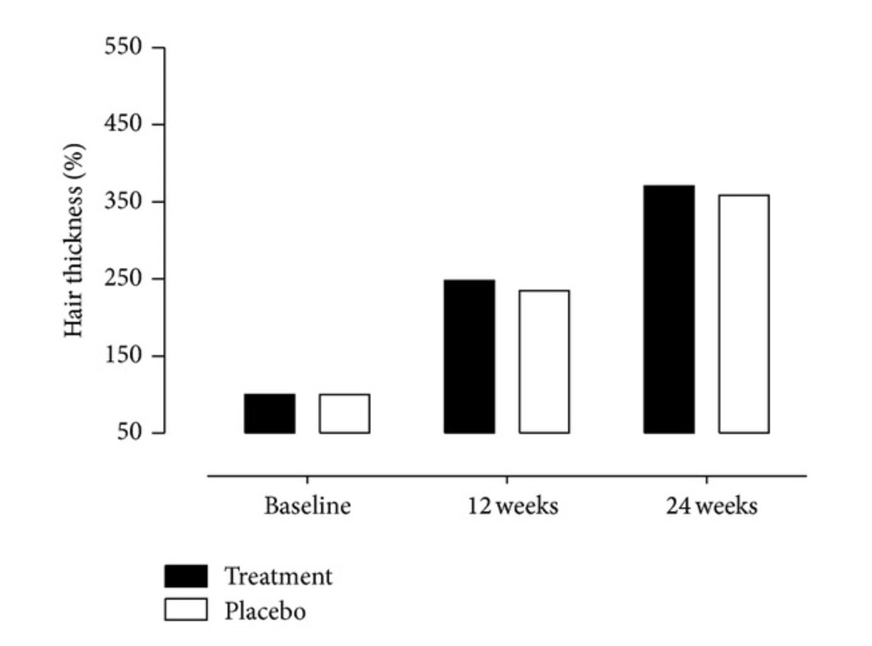
Now look at measures of hair thickness. Placebo and treated are the same after 24 weeks, and both changed by over 300% in just 24 weeks. Wow! Take a placebo and increase hair thickness by 3X. Let’s all take placebos. Obviously, these data are bogus.

Looking more closely, the second figure shows us that in 24 weeks, the pumpkin seed oil group saw hair thickness increase ~360%. And the placebo group was 350%. The delta hair thickness from baseline to 24 weeks was 0.34 ± 0.03 for the treated versus 0.34 ± 0.02 for the placebo. That’s one heck of a placebo! Many factors contribute to hair growth, including the seasons of the year. What accounted for the increased hair thickness in the treatment and placebo groups? We just don’t know.

So is pumpkin seed oil alone as good as Finasteride alone for growing hair? The short answer is no. Finasteride is a synthetic compound that acts to directly inhibit 5-alpha reductase. Finasteride, once metabolized in the body, directly inhibits 5-alpha reductase at the biochemical level. In contrast, pumpkin seed oil might not directly inhibit 5-alpha reductase. Rather, pumpkin seed oil might indirectly inhibit 5-alpha reductase by reducing inflammation.

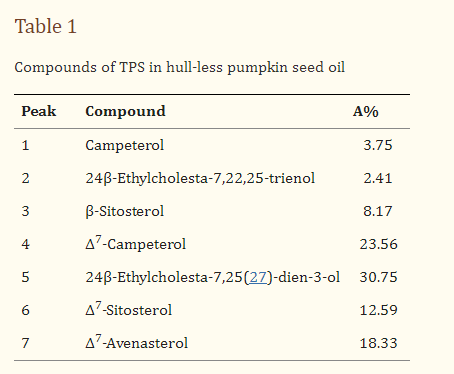
Pumpkin seed oil contains many phytosterols as shown in Table 1 (from Kang et al, 2021). These phytosterol compounds have anti-inflammatory effects. β-Sitosterol, for example, is a well known anti-inflammatory.

Inflammatory, damaged tissues release signaling molecules that recruit inflammatory cells to an injury. This process has evolved to fight infection. Hormones, such as DHT, are also involved in healing. When these signaling proteins recruit inflammatory cells to arrive at damaged tissue, expression of the hormone DHT (and the 5-alpha reductase enzyme) occurs at the same sites. The increase in 5-alpha reductase and DHT are responses to the inflammatory process to help dampen inflammation. Therefore, if pumpkin seed oil (PSO) reduces inflammation, and dampens pro-inflammatory signaling that recruits inflammatory cells to our damaged tissues, PSO may also indirectly reduce 5-alpha reductase expression and thereby DHT. This would happen because if there aren’t any signaling molecules turning on 5-alpha reductase, testosterone won’t convert into DHT in those tissues.

Finasteride is a competitive inhibitor of the type II and III isoenzymes of 5-alpha reductase. This difference, direct versus indirect 5-alpha reductase inhibition, is probably why those consuming pumpkin seed oil don’t report the same psychological and sexual negative side effects as those using Finasteride, despite both reducing 5-alpha reductase expression and therefore DHT levels.

Chronic scalp inflammation is closely linked to hair loss through a inflammatory infiltrate in the blood vessels feeding the hair folicles. Chronic inflammation promotes the formation of arterial plaque (atherosclerosis) in the vessels supporting our hair follicles. Over time, this arterial plaque builds up and leads to scarring and arterial calcification. This is the so-called “hardening of the arteries.” This calcification also occurs in the blood vessels supporting our scalp hair follicles. The end effect: reduced blood flow and nutrient/oxygen delivery to the scalp hair follicles – causing our follicles to miniaturize, shrink, and eventually disappear.

Important to delivering nutrients from the blood vessels to the tissues, including hair follicles, is normal functioning of nutrient-transporters. The transporters actively carry the nutrient from the blood vessels into the the tissue. And what does inflammation do to the transporters? The transport activity is negatively regulated by inflammatory cytokines (Seno et al, 2004). If we want to prevent or reverse hair loss, we need to reduce arterial plaque build-up and inflammation in our blood vessels. Pumpkin seed oil is one of many things we need to consume to help do this.

As Knussmann et al (1992) have stated, “The widespread assumption that androgen levels are in general elevated in bald-trait men must therefore be rejected.” Rather, in balding, young men, “significant values were observed in the case of the metabolic rate of dihydrotestosterone/testosterone and the proportion of free to total testosterone. Evidence suggests that balding is a more complicated result of hormonal imbalance. Looking beyond DHT and considering blood hormonal profiles, hair loss is closely connected to a few different hormonal imbalances. These hormonal imbalances vary based on the age, gender, and type of hair thinning from which a hair loss sufferer has. It’s complicated, for sure. But these different hormonal conditions all are suggestive of one thing, namely systemic inflammation. For example, according to the studies by Sanke et al (2016), “Men with early AGA could be considered as male phenotypic equivalents of women with PCOS.”  People with PCOS have higher levels of inflammatory markers such as C-reactive protein (CRP), white blood cells (WBCs), and inflammatory cytokines. This inflammation can lead to polycystic ovaries producing androgens.

To summarize, although the positive effects of pumpkin seed oil on hair growth have been overly hyped because of flawed studies, pumpkin seed oil has benefits to the body and likely provides benefit to the scalp and to growing hair through its anti-inflammatory effects, which then controls DHT levels in the hair follicle.