There’s a big difference between glycation and glycosylation. Glycation is unhealthy, glycosylation is predominantly beneficial.
Glycosylation refers to an enzyme-mediated modification that alters protein function, for example, extending their life span by protecting against denaturation or proteolytic degradation. Glycosylation can also enhance a protein’s interactions with other proteins. By contrast, glycation refers to a monosaccharide (usually glucose) attaching nonenzymatically to the amino group of a protein. In other words, the enzymatic cross-linking of carbohydrates to other organic molecules, such as proteins, is called glycosylation and is an important post-translational modifications of proteins, essential for human cell signaling and metabolism. Glycation is different than glycosylation. Less commonly known is the non-enzymatic and less specific reaction called the Maillard reaction, after its discoverer Louis-Camille Maillard. This is the reaction that underlies the browning of bread. The Maillard reaction takes place in multiple steps, leading to the irreversible formation of advanced glycation end products (AGEs). In the early steps of the reaction, the sugars can react irreversibly with amino acid residues of peptides or proteins to form protein adducts or protein crosslinks. Initially this step of glycation affects the interactions of collagen with cells and extracellular matrix components. However, the most damaging effects of glycation are caused by the formation of glucose-mediated intermolecular cross-links. The cross-linking decreases the critical flexibility and permeability of the tissues and reduces cellular turnover. Advanced glycation end products form and bind to long-lived proteins in the skin, cross-linking them, damaging their structure, deforming their fibers. Many proteins in the skin, including collagen, can be long lived. That is, these long lived proteins don’t turnover for years, sometimes decades. As such, they are susceptible to damage, including through glycation. This glycation of collagen in the skin, noticeable as browning skin, likely means glycation of the collagen is happening in other parts of the body, including the cardiovascular system.
In the last step, when oxidation is involved, the products are called advanced glycation end products (AGEs). AGEs are formed through four pathways: (1) the Maillard reaction, (2) sugars auto-oxidation pathway, (3) lipid peroxidation pathway, and (4) polyols pathway. Glucose is converted into fructose via the polyol pathway (based on aldo-keto reductase enzymes), which accelerates the production of AGEs. The formation of AGEs is a slow process that occurs physiologically in vivo, with higher accumulation of AGEs in tissues with slow renewal rates, such as the skin’s long lived proteins. AGE levels are increased in patients due to increased production, but they are also increased due to impaired excretion. In conditions such as metabolic and oxidative stress, AGE accumulates more rapidly. New, non-invasive assessment techniques of AGE are now available. The measurement is made using skin autofluorescence.
Not only is the skin autofluorescence (SAF) a measure of AGE in the skin, but the value determined in the skin is highly correlated with that in other parts of the body. That is, the measurement of AGE accumulation in the skin can serve as a biomarker for disease states other than those in the skin, including cardiovascular disease and diabetes mellitus. Chronic kidney disease has also been recently shown to correlate with SAF. As I have said previously, the health of the skin is an important biomarker for the health of many other organs in the body.
Not surprisingly, an environmental factor that is likely to have a profound effects on AGE accumulation is diet. Studies have shown that breastfed infants, consuming few AGEs, had lower SAF intensities than formula-fed infants, a diet rich in AGEs. Meat consumption is also associated with higher AGEs, where lower SAF values have been observed for vegetarians in hemodialysis patients.
In addition to environmental factors, herditary factors are likely to contribute a small amount to the observed AGE phenotypes as measured by SAF. Studies of twin and sibling pairs have implicated heredity as partly responsible for lens and skin fluorescence variations.
So what can we do? Reducing our consumption of sugars and simple carbohydrates is one obvious prophylactic measure. Another is reducing one’s consumption of meat, and eating a diet rich in vegetables. And, because environmental (dietary) AGEs promote inflammatory mediators, leading to tissue injury, restriction of dietary AGEs will suppress these effects. This is true in the skin, as well as throughout the body. Further, because metabolic state, and oxidation are important to driving the formation of AGEs, in addition to healthy lifestyle and dietary practices, one can use a course of topically applied skin care products to promote better metabolism, increased anti-oxidative capacity, and a renormalization of the extracellular matrix (ECM) in order to better prevent glycation and the formation of cross-linking and AGEs in the skin. Important to a skin care routine to prevent and remediate AGEs is the inclusion of NeoGenesis’ S2RM technology to prevent and remediate damage to the ECM and to provide a wide variety of antioxidants.
Adipose-derived stem cell secretome has been successfully used for treatment of various diseases, e.g., multiple sclerosis, rheumatoid arthritis, osteoarthritis, fistulae, diabetes mellitus, autoimmunity, and cardiovascular diseases, but also in skin aging, skin diseases, and wound healing. Let’s focus on the skin wound healing and aging.
Skin derived adipose mesenchymal stem cell (AMSC) secretome is a key component in the S2RM technology used by NeoGenesis in many of its skin care products. These mesenchymal stem cells are found in the hypodermis and dermis of intact, normal skin. Secretome is the complete set of molecules released by the AMSCs, the same set of molecules that the AMSCs in the skin normally release to help maintain and heal the skin. Secretome is what we call “stem cell released molecules (SRM)” at NeoGenesis. All the molecules released by the stem cell. And the “2” is present because we use the SRM from two types of skin derived stem cells, hence S2RM. So what we’re using at NeoGenesis is the complete set of all stem cell released molecules from two types of skin-derived stem cells, including the AMSCs. The other stem cell type used in the S2RM are fibroblasts derived from the skin. Fibroblasts are progenitor cells that are distinct from mesenchymal stem cells. Here’s a quick look at why this skin-identical ingredient, S2RM, is so useful in skin care. We’ll focus on the AMSC component of the S2RM. In another post, I’ll describe the many benefits of the fibroblast secretome. The approach we use at NeoGenesis is what I call, “Stem cell therapy without the cells,” a methodology that uses the many molecule types released from skin resident stem cells to renormalize the skin’s physiology.
The skin is physical barrier against physical, chemical, and biological damage. It is normally self-repairing, and protects against dehydration and thermal, pathogenic, chemical, and physical stress. Repairing physical damage in the skin is a dynamic process involving five overlapping stages of homeostasis, inflammation, proliferation, re-epithelization, and fibrosis. In clinical practice, AMSCs are usually administered as part of fractionated adipose tissue i.e., as part of enzymatically isolated stromal vascular fraction (SVF or cellular SVF), mechanically isolated SVF (tissue SVF), or as lipograft. AMSCs, as part of the full thickness skin grafts, have been used by physicians in their practices beginning in 1875 when Hungarian-born Scottish-trained surgeon John Reissberg Wolfe first developed the technique.
Let’s explore some of the mechanisms by which AMSCs exert their maintenance and repair of the skin. The mechanisms are complicated, and I’ll give you a glimpse into the many proteins and pathways that underly how AMSCs work in the skin. I’ve published on the immune modulating actions of AMSCs, and those of you interested in those aspects of AMSCs can read the paper as a free, open-access PubMed listed journal article. While the detailed pathways I write about below may not be important to those of you who are not scientists, what’s of value is to recognize the many pathways and many molecules types that are involved in maintaining and healing the skin. Products using one or a few peptides or proteins for example, will have minimal effect in bringing the skin to a healthy physiological state. In contradistinction, products that contain the many molecule types, such as S2RM, needed to maintain and heal the skin, will bring safe and efficacious results.
As part of their secretome, AMSCs secrete four key growth factors that promote re-epithelization: EGF, FGF-2, IGF-1, and TGF-β. These proteins induce the mechanisms underlying tissue repair including cell migration, proliferation, and differentiation as well as angiogenesis, extracellular matrix production, and inflammation resolution. Studies have found that co-treatment of AMSCs and AMSCs secretome increases the proliferation of dermal keratinocytes and fibroblast in the skin, and the maturation of fibroblasts through, at least partially, the upregulation of microRNA. Other studies have found that AMSC secretome prevents flap necrosis (cell death) after skin flap transplantation by increasing proliferation and secretion of IL-6. Another study found that AMSC secretome enhances skin flap recovery by reducing inflammation and apoptosis. AMSC secretome also prolongs the survival of vascularized composite allografts after transplantation by immune modulation, downregulating CD4+ T and Th1 cells and upregulating Tr1 and Treg cells. This paper exemplifies that the use of AMSCs secretome is an important new approach in reconstructive and plastic surgery. This is the all-important regulation of the immune system that is necessary for wound healing as described in my recent paper.
Key to tissue repair is the mitigation of inflammation. In addition to secreted immunomodulatory proteins by AMSCs, it is possible to modulate inflammatory pathways by microRNA in the AMSC secretome. Studies have found that AMSC secretome contains miR-21, which increases migration and proliferation of HaCaT (keratinocytes) cells by enhancing the matrix metalloproteinase 9 (MMP-9) expression in the PI3K/AKT pathway, thereby increasing wound healing. Also, miR-19b from AMSC secretome enhances wound healing by regulating the TGF-β pathway through targeting chemokine C-C motif ligand 1 (CCL1) by modulating the CCL1/TGF-β signaling axis. Delving more into these mechanistic pathways, TGF-β secreted by AMSCs has been found to act synergistically with growth differentiation factor 11 (GDF11) to reverse keratinocytes aging and trigger skin rejuvenation. Enhanced re-epithelialization, collagen remodeling, angiogenesis, and vessel maturation leading to improved wound healing were also found in diabetic mice treated with engineered AMSC secretome containing miR-21-5p. In digging deeper into these pathways, keratinocyte proliferation and migration and accelerated wound healing were induced through the Wnt/β-catenin signaling pathway in vitro, confirming earlier results where AMSC secretome was found to improve wound healing also through the Wnt/β-catenin pathway. AMSC secretome can also be used in alleviating atopic dermatitis.
Studies have found that an in vivo model of atopic dermatitis after AMSC secretome injection exhibited reduced clinical score, decreased level of inflammatory cytokines, serum IgE and blood eosinophil counts and CD86+ and CD206+ cells in skin lesions, as well as diminished infiltration of mast cells. Moreover, it has been shown that levels of inflammatory cytokines such as IL-4, IL-23, and IL-31 were reduced. Recently, Shin et al. found that not only the levels of these cytokines are reduced after AMSC secretome treatment in atopic dermatitis, but also IL-5, IL-13, TNF-α, IFN-γ, IL-17, and TSLP were reduced. The study also demonstrated that AMSC secretome restored expression of genes responsible for lipid metabolism, including ceramides, the cell cycle, a normal inflammatory response, as well as improving the skin barrier.
Furthermore, AMSCs and their secretome can be used in skin rejuvenation and wrinkle reduction, partly by stimulating collagen synthesis and regulating the proliferation and migration of dermal fibroblasts. You can think of wrinkles as a type of wound. Other studies have demonstrated the protective function of AMSCs secretome on dermal fibroblasts and keratinocytes against UVB-induced photoaging. They found reduced skin cellular senescence was observed in the group given AMSC secretome after UVB irradiation. Moreover, treatment with AMSCs secretome improved collagen I, collagen III, elastin, and TIMP-1 expression. AMSC secretome treatment was also able to upregulate the antioxidant response element (ARE), thus preventing and remediating damage to lipids, proteins, and DNA in the skin.
These examples provide a glimpse into the complexity of maintaining and healing the skin, and exemplify why carefully formulated products that contain a multitude of skin-identical proteins, such as the S2RM in NeoGenesis products, are critical to providing a natural, safe, and efficacious means for skin care.
People judge other’s traits based on facial appearance, and these inferences guide social interactions and avoidance. Facial skin blemishes and smoothness influence trait impression.
Healthy skin is beautiful skin, and that matters in a number of ways. I’ve frequently discussed how healthy skin, without chronic inflammation, is a means to better control systemic inflammation. That is, inflammation in the skin translates to inflammation in the body. Reducing inflammation in the skin, even in just the outer layer, the skin’s epidermis, results in reduced systemic inflammation.
Healthy skin is also important for other reasons, including our social interactions. People rapidly judge others based on the appearance of skin, especially facial skin. Studying ancient cultures, one can find beliefs that the face is a window to a person’s true nature. In Western culture, Kaspar Lavater (1800), a Swiss pastor, is given much credit for spreading the ideas of physiognomy, the “art” of reading personality in faces. Lavater said, “Whether they are or are not sensible of it, all men are daily influenced by physiognomy.” Unfortunately, when making social attributions from faces, people are making too much out of too little information.
In a studyfrom 2018 of skin smoothness and skin blemishes, scientists found these skin states to be critical for how people judge other’s traits. Across ratings of trustworthiness, competence, maturity, attractiveness, and health, the negative influence of skin blemishes was stronger and more consistent than the positive influence of skin smoothness. Further, the presence of skin blemishes diminished the positive effect of skin smoothness on attractiveness ratings. In sum, both facial skin blemishes and facial skin smoothness influence trait impression, but the negative effect of blemished skin is larger and more salient than the positive effect of smooth skin. To be clear, results of their study found that faces with skin blemishes were seen as less trustworthy, competent, mature, attractive, and healthy compared to the unmanipulated version of the faces. Results for the smoothed faces were less clear-cut.
Caring for your skin, therefore, is not only important for maintaining the health of the body’s largest organ and a huge component of your immune system, but also for one’s social interactions and psychological health. Be very careful of what products you use on your skin, eat a plant-forward diet to provide the nutrients your skin requires to be healthy, exercise, and expose your skin to only moderate amounts of sunlight – small amounts are beneficial. Healthier skin will result. Considering products used on the face, the positive effects of exercise on the skin can be mimicked by injecting IL-15 into the skin. The positive effects of a low dose of IL-15 can likely be derived from NeoGenesis Recovery, which contains the IL-15 cytokine in its S2RM technology, a natural and balanced mix of many skin-identical proteins, sourced from skin resident adipose mesenchymal stem cells. This is one of many benefits using S2RM technology in NeoGenesis products.
The recent spate of start-up skincare companies featuring technologies that rely on one one magical ingredient belie the complexities of the skin’s physiology – When will they ever learn about “Systems Therapeutics for Physiological Renormalization”?
Some recent examples of magic bullets being funded by venture capital and brought to the market by their marketing puppets include: the long-available and widely used ingredient called, phytosphingosine; a peptide du jour called OS-01 Peptide; another peptide du jour with the tradename, LIPOXERASE. I could go on, but these are a few examples that popped up on my radar over the weekend. Let’s be clear, the mindset of these private equity funded skin care companies is to develop skin care products in the same manner as drug companies. That mindset is reductionist, meaning that they feature one ingredient as a “cure all.” But making drugs that cure a disease is a bad business model – if it’s cured, the customer goes away and money is lost. The reductionist strategy is why most drugs don’t work, and most have serious negative side-effects. I wrote a book about this. Pharma knows it. Often the key is to develop one ingredient for which a patent can be attained. It doesn’t matter if the patented ingredient really works, it just matters that a patent is in place. Once the patent is granted, no one else can use the ingredient for about 15-20 years. This makes for great marketing hype in the USA. A new patented ingredient will spread like wild fire through the corporate media circles, and having heard the corporate media hype thousands of times over, many will believe the nonsense. These companies will make money, because with private equity behind them, they’ve got the money to hire the Mad Men. Private equity is a huge negative for healthcare. It doesn’t matter that the new patented or “patent-pending” (anyone can say this) product doesn’t work well, media hype will say that it does and people will buy it. Private equity makes money, your skin will whither.
So when will these people learn about “Systems Therapeutics for Physiological Renormalization“? The skin has a very complex physiology. And when you have a skin disease, the changes in physiology are complex. The disease is not about one pathway in the skin changing, and then using one ingredient to fix the pathway. Rather, disease is complex and involves many pathways, and a systems therapeutic that targets multiple pathways underlying the disease is required to significantly ameliorate the disease. That means many molecule types are delivered to the skin to renormalize the physiology, affecting all or many of the pathways underlying the disease, and to bring the skin back to a non-diseased state. This is the approach we use at NeoGenesis, the skincare company that I co-founded. We use a multitude of molecules, most of which are skin-identical, to renormalize the skin’s physiology. Those skin identical ingredients include the S2RM molecules – a collection of many molecule types that are released from adult stem cells derived from human skin. These molecules are an example of endogenous skin identical ingredients, because they are molecules produced by cells in the skin. We also use exogenous skin identical ingredients, such as Vitamin C, A, and E and essential fatty acids, that are derived from a healthy diet. These are all skin identical ingredients because they are normally found in the skin and man evolved to naturally use these ingredients, whether they are made in the skin or acquired through diet. Choosing a myriad of healthy ingredients with which man co-evolved is how I formulate our products at NeoGenesis. It’s not about one magical ingredient, it’s about a collection of healthy ingredients.
Some ignorant, non-scientist, physicians who are retired and lost their medical license for incompetence are pushing some marketing hype about lyophilized exosomes for skin care. Let’s see why this lyophilization technology is for the convenience of the company, and to the detriment of the secretome/exosome product.If left in their natural state, the way NeoGenesis does in its products, exosomes are highly stableand maintain their natural penetration abilities. So good are exosomes at penetrating barriers that they are now being used for drug delivery.
Have you ever had freeze-dried food? It’s not very good. But it is convenient. Hiking, camping, or traveling through outer space, freeze-dried food is convenient. You won’t find it served at your local three-star Michelin Guide rated restaurant (I double checked the menu of my local 3 star Michelin restaurant and found no freeze-dried food on the menu). The texture and taste is off. Exosomes, when they’re freeze-dried, called lyophilized in the industry, suffer a similar fate as the freeze-dried food. Their texture and function is degraded, but it sure is convenient for the company – it’s a means to easily and cheaply store the exosomes. Put the lyophilized exosomes in a jar, store them in your company’s closet for decades, and then suspend them in water for use. Or ship them across country to unsuspecting customers because shipping powdered exosomes is cheaper and easier than shipping fresh exosomes. This is what AnteAge is doing. Making freeze-dried, powdered exosomes. What should we expect from a company founded and run by two physicians, John Sanderson, who lost his medical license for repeated incompetence and sexual abuse of his patients, and George Taylor, a retired medic living in Florida. George Taylor’s life work as a practicing anesthesiologist was standing around watching patients sleep as other physicians performed operations on the patient. Hardly a life of science, and a profession that had to have bored him silly. And I do mean silly. Just look at the silly BS he promotes. Laughable, and reminiscent of his days in the OR with too much laughing gas (nitrous oxide). Neither are scientists, nor have they ever published any scientific papers. They do have, however, a history of business fraud as I wrote about in another blog.
First, what are exosomes? About 20 years after the discovery of liposomes, scientists discovered similar lipid vesicles form naturally in living organisms. These include membrane-contained nanosized extracellular vesicles (EVs), secreted from cells as part of their normal process. This is a natural means by which cells in our body communicate with one another, and maintain and heal our tissues. We’ve known for many years that exosomes secreted by cells in the skin are important for the skin’s natural processes. Based on the origin and size of the EVs, as well as on the current understanding of their biogenesis, the vesicles are grouped as follows: exosomes (diameter ∼30–150 nm); microvesicles (100 nm–1 μm); and apoptotic bodies (50 nm–5 μm). So the exosomes we’re talking about are nanospheres, 30-150 nm in diameter, composed of a lipid bilayer and containing a cargo of proteins and microRNA, with proteins and other molecules tethered to the outside or embedded into the lipid bilayer structure. Despite the evident similarities to liposomes, exosomes exhibit certain advantages, which make them a preferable drug delivery vehicle. As a result, in the last few years, exosomes have become preferable over lipid nanoparticles as prospective drug carriers.
Let’s look at why exosomes, which I described in my peer-reviewed book chapter in 2016, are degraded during these harsh freeze-drying procedures. Both the proteins in the exosome and on the surface of the exosome can be damaged during the lyophilization process of the exosome. Yes, even the proteins inside the exosome can be damaged by lyophilization. Damaged proteins can cause many health problems. You don’t want to be using a freeze-dried product with damaged proteins! The exosome surface proteome, termed the surfaceome, serves as the main communication hub between an exosome and the extravesicular environment (Wollscheid et al., 2009). For exosomes, the molecules on the surface of the exosome impart many functional qualities, such as penetration through barriers, targeting, and gain of entry into target cells. I discuss some of this in a recent blog. As a surface component, this compartment of proteins on the exosome often reveals the first signs of distress and disruption, and is of substantial interest to the scientific community for diagnostic and therapeutic development of exosomes, and especially enabling the exosomes as a therapeutic-delivery vehicle. We can say the same for surface glycoconjugates on the exosomes, which play important roles in exosome biogenesis, release, targeting, and uptake by cells. These important functional qualities ascribed to the glycans on the exosome’s surface can be disrupted by lyophilization. In other words, the exosome’s surface has been denuded by lyophilization, resulting in all those functions imparted by the surface proteins and glycans being lost. It’s like stripping the surface components off of a truck, such as its tires, so that the truck can no longer deliver its cargo to the destination. Its also like stripping the handles off the truck’s cargo door, so that the cargo can’t be delivered even if it did arrive. I could go on, but enough of the analogies.
The bottom line is that fresh secretome/exosome preparations are much more functional and efficacious than are lyophilized (freeze-dried) and ultracentrifuged exosome preparations, because that harsh freeze-drying process or centrifugation process damages proteins (and other molecule types) on the surface of the exosome as well as inside the exosome. Although it is more expensive and time consuming to work with fresh secretome/exosome preparations, companies, such as NeoGenesis and Skin Medica, who go through the pains and expense to prepare fresh sectretome/exosomes, offer a much more safe (this is a peer-reviewed, PubMed listed scientific study on the safety of the NeoGenesis secretome/exosome technology) and efficacious product than those who do the quick and dirty, inexpensive freeze-drying methodology.
Chemicals in Sunscreen can Penetrate The Skin and Become Systemic: Choose Your Sunscreen Carefully. Toxic chemicals, such as PFAS and Benzene have been found in certain sunscreen products
Chemical Sunscreensvs. Mineral Sunscreens
Sunscreens are important to keep the skin safe from exposure to damaging UV irradiation, something that increases the odds of skin cancer. Sunscreen use has been found to reduce the risk of melanoma. The most aggressive form of skin cancer is melanoma, arising when pigment-producing skin cells, called melanocytes, become cancerous in a state of uncontrolled proliferation. Melanoma is becoming more common every year. While people with dark skin are less likely to have melanoma, if they do develop melanoma their outcomes will be worse than those with lighter skin. Studies have found that exposure to ultraviolet (UV) radiation from the sun increases your risk of melanoma, especially if you had sunburns during childhood. Melanoma is distinct from non-melanoma skin cancers in that it tends to spread locally, regionally, and distantly. Once melanoma cells are formed in the skin, the melanoma cells send out messages that change the surrounding lymph tissue such that the lymph becomes more permissible to the spread of the melanoma cells to other parts of the body. An individual’s risk of metastasis (spread of the cancer) is directly related to the depth of invasion and ulceration of their primary lesion. This alone is why sunscreens are so important.
UV irradiation also causes oxidative damage in cells due to the release of inflammatory cytokines that in turn generate reactive oxygen species (ROS), damaging lipids, proteins and DNA. Premature aging of the skin results, with coincident inflammation. To keep the skin safe, reapplying sunscreen is recommended every 2 hours when out in the sun. This means that sunscreen stays in contact with skin over a long period of time. When products are applied to the skin, especially so-called leave-on products, your skin has long term exposure to the ingredients in the product. Many of the ingredients can absorb into the skin, and some of the ingredients may have negative effects. Careful choice of a product based on its ingredients is therefore critical to your health.
A recent report from the Environmental Working Group (EWG), a non-profit in the US, found that only 25 percent of the 1,700 SPF products reviewed offer good broad-spectrum protection without troubling ingredients. Many of the products don’t effectively block the damaging UV incident on the skin, and many contain ingredients that are harmful, such as oxybenzone (aka benzophenone-3). This ingredient is known as a chemical sunscreen as opposed to a physical block sunscreen. Mineral sunscreens, which are physical block sunscreens that absorb UV, are composed of the minerals zinc oxide and titanium dioxide. I use these two ingredients when formulating sunscreens for NeoGenesis because the zinc component blocks UVA and the titanium blocks UVB. Longer wavelength UVA penetrates deeply into the dermis. In contrast, UVB is almost completely absorbed by the epidermis, with comparatively little reaching the dermis. UVA is efficient at generating reactive oxygen species that can damage DNA via indirect photosensitizing reactions. UVB is directly absorbed by DNA which causes molecular rearrangements forming the specific photoproducts such as cyclobutane dimers and 6–4 photoproducts. Mutations and cancer can result from many of these modifications to DNA. The mineral sunscreens use small particles that sit on the skin’s surface and physically block and scatter only a small portion of the incident UV, but absorb most of the UV, keeping the UV rays from penetrating the skin. Chemical sunscreens work differently, allowing UV radiation into the skin. Once the UV is absorbed into the skin, the chemicals in the sunscreen, such as oxybenzone, avobenzone, octisalate, octocrylene, homosalate, and octinoxate, create a chemical reaction in which UV radiation is converted to heat, and the heat dissipates from the skin.
In 1997, a study in the Lancet found that substantial amounts of an applied sunscreen, oxybenzone, were absorbed and subsequently excreted in human urine. Although oxybenzone has low acute toxicity in animal studies, little is known about its chronic toxicity and disposition after topical application in people. A small randomized clinical trial published in May 2019 in the Journal of the American Medical Association (JAMA) found that four of the chemical sunscreens (avobenzone, oxybenzone, octocrylene, and ecamsule) were absorbed into the bloodstream at significantly greater levels than 0.5 nanograms per milliliter (ng/mL). That level of these chemicals is far above the amount at which the FDA requires topical medications that also use these chemicals to undergo safety studies to determine possible toxic effects. In other words, FDA approved drugs are being more carefully monitored for these toxic ingredients than are sunscreens.
Physicians will take a reductionist view of these data and say that the exposure to one of these ingredients is not harmful. They fail to understand that it is the totality of your exposures that will be harmful. We are bombarded with thousands of chemicals daily. The combination of chemical exposures is not understood. What is understood, very well, is that the increased exposure to chemical is leading to the rapid rise of diseases, and our exposome accounts for about 90% of all diseases. The popular media in addition to the medical journals, fails to understand their own reductionist mindset. Understand that the FDA is overworked and underfunded, and sometimes suffers from regulatory capture by corporations because we fail to pass laws that limit corporate money from influencing laws and regulations, such that unless a product is found to kill or maim you quickly, said product may not be properly regulated for many years. Only through the accumulation of observational data in the general population will most of the ill effects of a chemical be discovered. This is true for FDA approved drugs. Consider, many poor drugs go to market following biased, randomized, placebo controlled clinical studies and are then pulled from the market because observational studies in the general population find that they are unsafe. These are real-world observational studies, not highly controlled clinical studies designed with a bias to attain a FDA approval. These are so called Phase 4 observational studies. The real-world observational studies of a particular chemical do so in a large group of people, more representative of the general population than a clinical trial, doing so for a longer period of time than a clinical trial. The real world studies are also done in people with normal exposure to other chemicals so better reflect a combination of exposures than do the clinical trials. How many times have I heard that “randomized control trials, considered the gold standard in research” are the way to understand something. This is absolute bullshit. Most of what we know about the universe, whether it is physics, chemistry, or biology is through observational studies. This is also true of FDA approved drugs. Most all of the preclinical research is observational, many of the clinical trials are observational, not controlled trials, and as I said, most of the Phase 4 studies that cause many drugs to be pulled from the market or relabeled, are observational. Sadly, many drug companies hide their safety data because it is damning for their drug. But using careful observation by those who don’t have conflicts of interest, much can be learned.
Further, if you want to understand why observation is key to understanding everything, read the book by UCLA professor, Dr. Judah Pearl, Ph.D., “The Book of Why.” Here you can learn why the phrase “Correlation is not causation” is bullshit. This mantra, chanted by physicians for more than a century, has led to a virtual prohibition on causal talk. Today, that taboo is dead. The causal revolution, instigated by Dr. Pearl and his colleagues, has cut through a century of confusion and established causality — the study of cause and effect — on a firm scientific basis. If you observe the rooster crowing and the sun rising, finding that they are strongly correlated, you can understand that the rooster does not cause the sun to rise by simple observation. The simple observational, not a randomized, placebo controlled clinical trial, is to shine artificial light on the rooster and observe that artificial light will stimulate a rooster’s crowing and the sun will fail to rise. DAH!
The chemical sunscreens are also damaging to marine life, including our beautiful and life sustaining reefs, including the coral Galaxea fascicularis, and have been banned for use in jurisdictions such as Hawaii (first in nation) and Key West, FL. However, Ron DeSantis and the Florida Legislature passed a bill to block Key West’s ban on chemical sunscreens. The beautiful, once protected reefs around the Keys that I dived as child growing-up in Miami continue to die. The protection began in 1960 under the progressive leadership of Republican President Dwight D. Eisenhower and Democratic Governor LeRoy Collins. Protection dies under regressive policies. As with sunscreen and drug exposures in humans, sunscreen exposure to marine life is only one of many toxic chemical exposures that may be killing our coral reefs. The National Academy of Sciences discusses it here, and their headline is: “Without a doubt, a variety of compounds present in the mixture of chemical pollution entering our environments are a contributing cause of ecological decline.” Let us please stop our reductionist thoughts on these chemical exposure problems – “it’s the combination, stupid.”
Sun care products that use physical sunscreens instead of chemical sunscreens limit exposure to ingredients such as avobenzone are also the better choice because the chemical sunscreen ingredients cause allergic skin reactions , behave like a hormone disruptor in many studies, and may cause more harm to children. Look for products that contain the physical UV blockers such as the minerals titanium dioxide and zinc oxide in a non-spray format.When in an aerosol spray, the product may also contain benzene, a powerful carcinogen and hematotoxin.
PFAS (Forever Chemicals)
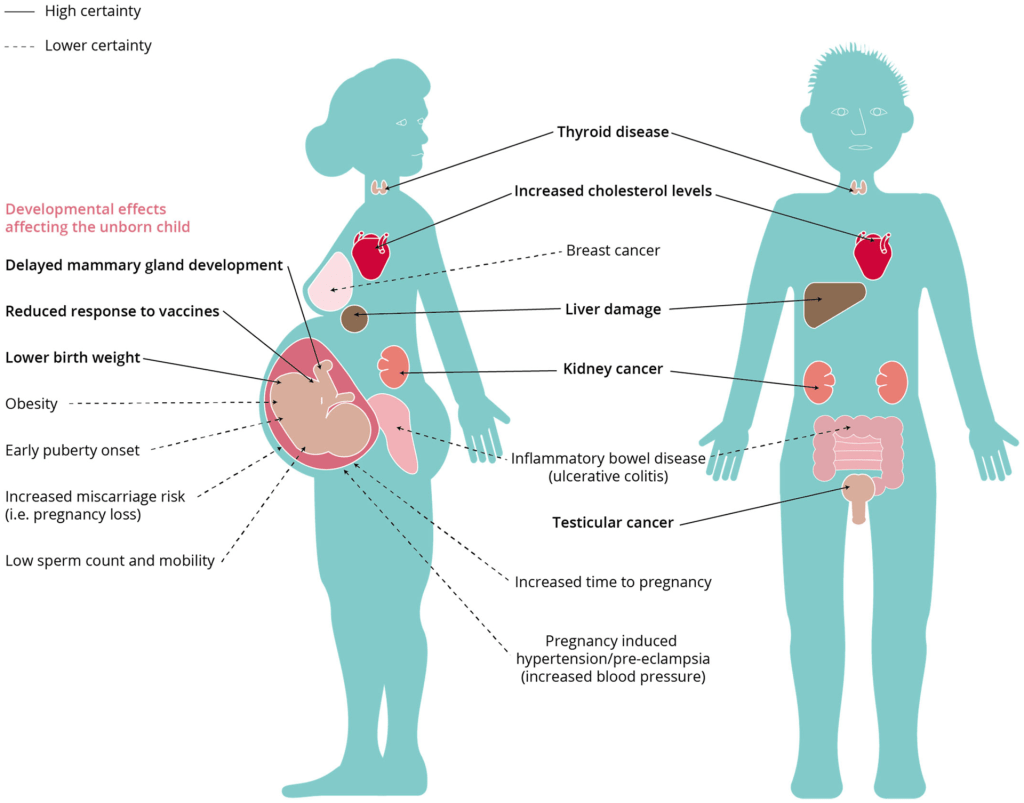
PFAS, a long lasting chemical found in many sunscreens has been banned in cosmetics by California (first in nation). PFAS do not naturally exit the body for many months or many years and are not known to degrade in the environment, they are considered “forever chemicals.” Widespread human exposure to PFAS in water, food, and air coupled with the lengthy environmental persistence and biological half-lives of months to years for some PFAS have led to measurable PFAS in the blood of nearly the entire population in developed countries, with health effects reported globally. While much work has provided evidence that these PFAS chemicals are damaging, more studies are required to better understand what can be done to mitigate their effects, especially given they remain in our environment for decades. Therefore, it’s imperative to reduce the amount of PFAS you are exposed to by food, water, and topical care products. Some of the damaging effects on the human body are illustrated in Figure 1. Be aware that the damaging effects may be more severe in children given their brain, immune system, and other organs are developing in a rapid manner where toxic chemicals may interfere with developmental signaling molecules in the child’s organs.
I’ve recently co-formulated a physical block sunscreen that has a completely safe and effective set of ingredients for NeoGenesis. Our product has no chemical sunscreen ingredients, no benzene, not an aerosol or spray, and no PFAS. Nothing but EWG approved ingredients. We’re currently finishing our testing and going through the approval process for bringing it to market. We’ll be launching our product soon. Stay tuned.
As Dr. Thomas Kuhn, a former physics professor at Harvard and Berkeley, taught in his book, The Structure of Scientific Revolutions, scientific fields undergo periodic “paradigm shifts” rather than progressing in a linear and continuous way, and that these paradigm shifts lead to new approaches in understanding what scientists would never have considered valid before. Such a paradigm shift is now underway for drugs and therapeutics, specifically for skin care, and has been described as “Systems Therapeutics for Physiological Renormalization.” Until now, the paradigm for drug and therapeutic development has been an ineffective reductionistic approach, where a small molecules was developed to target one pathway in an attempt to remedy the diseases or condition. Goodman and Gilman’s The Pharmacological Basis of Therapeutics, long believed to be the oracle for teaching pharmacology to physicians and other practitioners, taught that “the small molecule had to specifically hit its target, and only its one target.” That is, their misguided approach is to develop a drug or a product that specifically hits one target, and only one target, and that is thought to be the best way for drug or skin care product development. It’s nonsense. This doesn’t work well because all diseases and conditions of the skin involve multiple pathways at multiple levels in the tissue, and therefore multiple molecules, not just one, are required to renormalize the multiple pathways in the diseased tissue to ameliorate the disease or condition.
Examples in skin care of this reductionist approach are to offer products that focus on one antioxidant, namely Vitamin C, as a cure all. You’ll see many products on the market that prominently feature Vitamin C, and only Vitamin C, as their active antioxidant ingredient. Sometimes the product has C and E, and only C and E. Your body’s cells naturally produce many powerful antioxidants, such as melatonin, alpha lipoic acid, superoxide dismutase, and glutathione. The foods you eat supply other antioxidants, such as vitamins C, ergotheoneine, carotenoids, and vitamin E. Many antioxidants, including these and others, naturally work together in the antioxidant cascade. It’s not just about Vitamin C. Too much Vitamin C can actually be oxidative and potentially damaging, and inhibit other normal biochemical pathways in the body. The evidence is not clear about the damaging effects, but too much is suboptimal. Rather, it’s about a combination of different types of antioxidants used together. Just as nature intended. This is clear, you need a wide variety of antioxidants, not just vitamin C. It’s similar to when you eat a wide variety of fruits and vegetables, with all those different colors due to the different kinds antioxidants and other molecules they contain. All of those different molecule types are required to keep us healthy. And many of those colorful molecules will be pumped into the skin from the blood supply, feeding the skin from the inside-out. When formulated properly and applied topically to the skin, most of those molecules can feed the skin from the outside-in.
Most diseases and conditions involve many perturbed pathways, and a product that targets only one of these many pathways is a product doomed to failure or suboptimal therapeutic effect. As an example, such is the case for well over 50% of the FDA-approved drugs on the market today, they don’t work. The drugs that don’t work include many cancer drugs, that are toxic and only cause harm. While this problem has received media attention, the world’s largest lobby, the medical-industrial complex, drowns out these reports by saturating the media with drug propaganda. This way of thinking permeates social media, and many skin care products will tout their favorite ingredient in a reductionist manner. That is, they tout one ingredient as a cure all. EGF products are an example of this nonsense. They promote one growth factor out of hundreds that used in the skin’s biochemical pathways. EGF alone will puff up the face like a balloon, causing depilation (loss of hair). It’s not healthy.
This problem of reductionism only became worse when physicians, such as Francis Collins, ushered in genomic fashionistaism, teaching that the small molecules should not only hit just one target, but that the target should be at the level of the genome. As Dr. Stephen Rappaport, Ph.D. at Berkeley teaches us, over 90% of diseases are caused by our exposome and mutations in the genome are not the underlying cause. Yet, Collins in all of his ignorance, called for genetically sequencing everyone, carrying your genetic sequence on a card that can be read by physicians, such that the physician can then treat you based on the information contained on your “genomics card.” Another physician, Leroy Hood, was quoted as saying, ” your entire genome and medical history will be on a credit card. You just put it in there [a computer] and a physician will instantly know what he’s dealing with.” Besides irrational thought underlying Collin’s call for a “genome card,” fraud was in his calling to make such ignorant claims. Publishing five fraudulent paper on genomics. When found out, Collins said, “the significance and the scope of the fabrication in this circumstance, of which I had not the slightest idea, began to be very apparent.” In other words, Collins had no idea what was going on in his lab, and was attaching his name to “scientific papers” of which he had nothing to do with. This is called “ghostwriting,” where physicians put their names on “scientific papers” yet have had nothing to do with the study. The practice is rampant for practitioners, i.e. physicians. Leading other physicians astray, who control over 95% of biological research spending in the US given that physicians control the National Institutes of Health, Collins would cause biological research in the USA to be highly biased towards looking for diseases in all the wrong places – the genome. This mentality of looking for disease in all the wrong places has hit skin care and the beauty industry. At Neogenesis, I formulate products that are based on the “systems therapeutics for physiological renormalization” approach, where our core technology, S2RM Technology, is compromised of hundreds of proteins native to healthy, young skin, that can be returned to aged and/or damaged skin through simple topical application. And, the molecules in S2RM are used in combination with other skin identical ingredients, such as Vitamin C, Vitamin E, ergotheoneine, carotenoids, SOD, urea, squalane, ceramide, etc, to renormalize the skin’s physiology. It’s a natural, efficacious, and safe approach to skin care. All of the ingredients in the products are carefully chosen to not induce inflammation or an allergic response.
The reductionist and genomic bias continues today and has been taken to such an absurd level that almost every gene studied has been linked to a disease. Further upsetting those who believe that mutations in the genome underlie disease, is that mutations in the genome don’t happen just by chance, but are driven by environmental influences. Basically, one’s health status is not only influenced by your current environment acting at the protein level of your body, but also by what your ancestors experienced in their environments acting on their genetics and epigenetics. So what you do in life, including your diet, directly effects your health and can cause most diseases, but also will have consequences to your children and their children. As such, when what one has experienced in life disrupts their physiology, mostly acting at the protein level of the body, the resulting disease can be treated by renormalizing the physiology. This means, renormalizing the protein (and other molecules such as lipids) content of the afflicted tissues. As Dr. Daniel Nomura, Ph.D,, professor at Berkeley, has written, “Many diseases, including cancer and monogenic diseases, are often caused by specific proteins that are abnormally degraded and lost from the cell.”
As an example of the therapeutic benefit of this “systems therapeutic for physiological renormalization” approach, our group has demonstrated its efficacy in the skin for a number of conditions, including radiation dermatitis in cancer patients. The approach was also shown by Maguire and colleagues to be effective in protecting the nervous system from neurodegenerative diseases in an experimental animal model. The safety of this technology has been demonstrated, and the mechanism of action partially described. The approach has also been discussed in an interview of Dr. Greg Maguire by Dr. Tom Kleyman of the Physiological Society. Dr. Maguire has also recently described in a journal publication, Human Vaccines and Immunotherapeutics, how the “systems therapeutics for physiological renormalization” approach may help to make safer and more efficacious vaccines, helping to better prevent the spread of the disease. I’ll be speaking about this an upcoming talk at the 8th Annual Vaccines Research & Development congress in Nov. 2023. The point here is that this strategy of using a systems therapeutic (many types of molecules) to bring about physiological renormalization (restoring normal protein content, for example) can work for all tissues and for all kinds of diseases and conditions, including those of the skin. Remember, it’s the proteins (plural!), stupid. Not the genome, not just one molecules.
Stay tuned, there is much more to come, including our approach in treating immune and autoimmune conditions, including of the skin, as I began to describe in my 2021 paper.
Atopic dermatitis (AD), an inflammatory skin condition is a form of eczema. Eczema refers to a group of conditions that cause inflamed skin. There are many types of eczema. Atopic dermatitis is the most common type. Recent studies of AD have found that both structural abnormalities of the skin and immune dysregulation play important roles in the pathophysiology of the disease. Impairment of epidermal barrier function, for example, owing to deficiency in the structural protein filaggrin, can promote inflammation and infiltration of immune cells, such as T cells. And, as we age, immune cells, such as macrophages, become more inflammatory because of a loss of certain calcium pumps within the mitochondria (mCa2+). Specifically, mCa2+ uptake capacity in macrophages drops significantly with age. This amplifies Ca2+ signaling in the cytosol of the macrophage and promotes NF-κB activation, rendering the macrophages prone to chronic low-grade inflammatory output at baseline and hyper-inflammatory when stimulated. This means if you have interrupted skin barrier, and a trigger penetrates and presents in the skin, older people will likely have an exaggerated, pro-inflammatory macrophage response that elicits an inflammatory cascade. While this phenomenon increases with age, many people with inflammatory skin conditions can experience this too. While macrophages are necessary for normal skin function, the inflammatory types are not. One way to reset macrophage types from an inflammatory state to an anti-inflammatory, pro-repair state is the use of skin derived mesenchymal stem cell secretome (stem cell released molecules). This so-called S2RM technology is available in Neogenesis Recovery. Our studies have found Recovery to work well to quell the inflammation associated with psoriasis and AD.
Therefore, optimal management of AD requires a multifaceted approach to heal and protect the skin barrier and address the complex immunopathogenesis of the disease. Other types of eczema include contact dermatitis, nummular eczema, and dyshidrotic eczema. People often say atopic dermatitis when referring to any one of these conditions. Although eczema involves an immune response, it is not considered an autoimmune condition because eczema is not self-triggered, rather it is induced by environmental factors. However, once chronic inflammation is induced, tissue breakdown from the inflammation can elicit an autoimmune response and become self-sustaining. That is, inflammation induces tissue breakdown that causes sterile inflammation, which then leads to further tissue breakdown. And the cycle continues. At this point, if the environmental trigger is stopped, an autoimmune response may continue from the damage signals emanating from the structural breakdown of the epidermis. This process is called inflammaging. People with AD have a higher prevalence and incidence of autoimmune conditions compared to the general population. BTW, the epidemiological terms, prevalence is about what’s out there, while incidence tells you what’s new.
In 2000, the American Academy of Dermatology (AAD) warned Americans: eczema was on the rise. In the warning, the group of dermatologists said that the rate of atopic dermatitis, a form of eczema, had nearly tripled since 1970. This provides evidence that the disease is a consequence of environment and not hereditary-genetics. At the time, it was estimated that nearly 6 percent of all Americans had the condition that can cause itchy, red, and scaly skin. Today, the National Eczema Foundation estimates that at least 10 percent of Americans have eczema, and that one in ten people will have eczema in their lifetime. I want to stress that this is an inflammatory disease where the skin’s innate and adaptive immune systems have gone awry. Immune cells are abnormally activated and may be found in parts of the skin, the epidermis, where they are not normally resident as happens in a similar disease called psoriasis. Itch (pruritis) is associated with neuroinflammation of the skin’s, part of the neuro‐immuno‐cutaneous (NIC) system. The skin’s microbiome will also be altered, a dysbiosis occurs where Staphylococcus aureus proliferates in overabundance. And remember, as I always stress, inflammation in the skin means inflammation in the body.
Exposure to tailpipe emissions is a big factor in eczema. Diisocyanates from auto exhausts show temporospatial and epidemiological association with AD while also inducing eczematous dysbiosis. As the authors of this study correctly point out, “The prominent AD paradigm is that the disease has a multifactorial pathology, but with frequent reference to genetic predispositions causing defects in barrier and/or inflammatory pathways. However, the stark post-industrialization increase in AD prevalence strongly suggests that environmental factors must play a substantive role.” In other words, eczema is another environmental disease – forget the genetics-hereditary hype.
What to do? Cleanse the skin daily with a gentle cleanser. No harsh alcohol cleanser or those with strong surfactants such as sodium lauryl sulfate (SLS). In this way you’ll remove those environmental toxins, antigens, allergens, and haptens that can trigger the inflammatory response. Use something mild like NeoGenesis Cleanser, or a similar mild cleanser. Be very careful to choose products without harsh chemicals that degrade the barrier and have allergic triggers. BTW, I’ve formulated a new cleanser for eczema and other inflammatory skin conditions that is currently in testing. More about this in future posts. I also have a new topical probiotic (yes, it’s really possible to do this) that I’ve formulated, also in testing. It remediates the dysbiosis associated with eczema. And because barrier function is perturbed in these conditions, using a product to restore the function of the stratum corneum and its barrier function is very important. This helps to prevent those environmental triggers from penetrating into the skin and inducing an immune response. Using a product, such as Neogenesis Barrier Renewal Cream, can help to rebuild the skin’s natural barrier function, preventing those triggers from entering the skin.
I have a trio of products that I’ve formulated for these skin conditions, and I’ll have more to say in the months ahead about how well they are working. The formulas are backed by decades of research, and while early results are promising, it will be interesting to see for what conditions they work best in real world studies. Stay tuned.
I was recently asked to review a cosmetic microneedling device white paper, meaning not a peer-review publications, rather an internal document generated by a company for sales purposes, from a company in Texas called Procell. As I’ve reported previously in peer-reviewed, PubMed listed papers, microneedling is a deep wounding procedure that activates the innate and adaptive immune systems and induces a wounded-proliferative state in the skin that is inflammatory and possibly pro-oncogenic. Sadly, this company, with its medical director (Mitchel Schwartz), who has no peer-reviewed publications and is paying for this study, is selling this product online and apparently making illegal sales to estheticians in states where microneedling procedures performed on others by estheticians is illegal.
The study in question here was performed by a physician in Canada who has no peer-reviewed publications, and the study, and the physician performing the study, were paid by Procell. The Procell device uses an array of needles that are 250 micrometers in length, with the thickness of the needles not reported. The device is run over the face such that these needles are puncturing holes in the epidermis and dermis at high rates, thus injuring both the epidermis and dermis.
The study design and the results are indicative of an inexperienced practitioner performing a study. First, the author states, “This study is a prospective, evaluator-blinded, single-site study, involving up to 30 subjects comparing clinical benefits after a treatment series versus baseline.” The claim of “evaluator-blinded” is ridiculous. Each subject serves as her own control, with photos being taken before and after treatment, and its easy for the evaluator to know who they are analyzing. Then they have a section called, “3.5 Randomization of Subjects.’ There is no randomization of the subjects. All are given the treatment. Next they say that “Photographic assessments will be conducted by a blinded expect evaluator.” I think they meant “expert” instead of “expect.” Although I think “expect evaluator” is the better descriptor, I’ll give them the benefit of the doubt. Regardless, the evaluator can easily identify each patient through their photos, and know what picture has been captured before and after the procedure. This is all just gobbledygook, and is either a consequence of ineptitude and/or fraud.
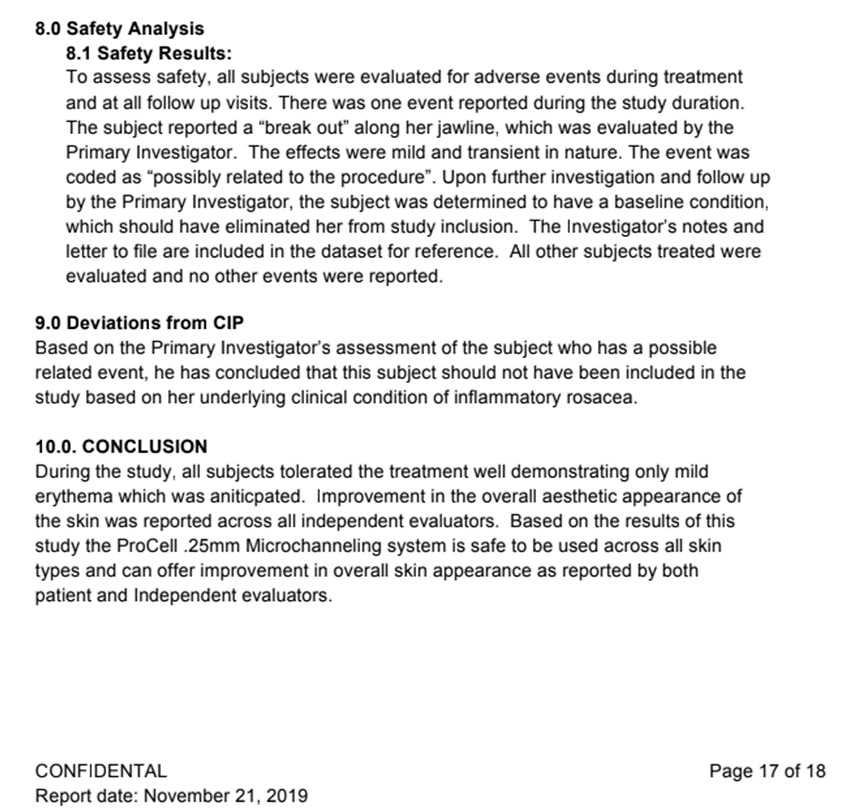
There are no results presented in the paper, only a conclusion. Yes, that’s right. No results are presented. What they do present in their “Safety Analysis” is a set on incongruous statements about how one patient was injured. Here’s what they reported in their “Safety Analysis”:
8.0 Safety Analysis 8.1 Safety Results: To assess safety, all subjects were evaluated for adverse events during treatment and at all follow up visits. There was one event reported during the study duration. The subject reported a “break out” along her jawline, which was evaluated by the Primary Investigator. The effects were mild and transient in nature. The event was coded as “possibly related to the procedure”. Upon further investigation and follow up by the Primary Investigator, the subject was determined to have a baseline condition, which should have eliminated her from study inclusion. The Investigator’s notes and letter to file are included in the dataset for reference. All other subjects treated were evaluated and no other events were reported.
My comment: (here they’re saying one of the patients had an adverse reaction)
9.0 Deviations from CIP Based on the Primary Investigator’s assessment of the subject who has a possible related event, he has concluded that this subject should not have been included in the study based on her underlying clinical condition of inflammatory rosacea.
My comment: (here they’re saying the physician screwed up and shouldn’t have included this patient in the study)
10.0. CONCLUSION During the study, all subjects tolerated the treatment well demonstrating only mild erythema which was aniticpated [sic]. Improvement in the overall aesthetic appearance of the skin was reported across all independent evaluators. Based on the results of this study the ProCell .25mm Microchanneling system is safe to be used across all skin types and can offer improvement in overall skin appearance as reported by both patient and Independent evaluators.
My Comment: (here they contradict themselves, saying that the procedure is good for all skin types)
Here’s an image from the study so you can see for yourself:
Combine this inflammatory-proliferative, injurious procedure with the bone marrow mesenchymal stem cell cytokines that they sell, and one has set themselves up for adverse events, possibly long-term. There are skin conditions for which microneedling, when not performed repeatedly, is beneficial and the benefits out way the risks. Acne scarring and other types of scars can be an example. To quell the inflammation associated with the procedure and to set the immune system into a anti-inflammatory, pro-repair state, use the S2RM technology, found to be safe and efficacious, contained in Neogenesis Recovery.
Wounding from procedures induces cellular replication, and replication may drive changes in cells and could push them toward a more tumorigenic state.“Tumors are wounds that don’t heal.”
Tissue specific stem and progenitor cells, such as the skin’s mesenchymal stem cells, fibroblasts, and keratinocytes, can persist during the lifetime or for extended periods of time in humans and contribute to both renewal and repair by giving rise to pools of progenitor cells that persist for various periods of time, replenish differentiated, i.e. mature cells, release many types of molecules involved in healing, and make short-term contribution to wound healing. Normally, these cell’s processes maintain and heal our skin throughout life. However, due to poor lifestyle, such as a diet that overfeeds us but under nourishes us, the nutrients needed to maintain proper function in these cells are lacking. Too much sun, leave-on products that are pro-inflammatory, and environmental exposures are other examples of lifestyle factors diminishing skin function. While hereditary and genetic factors may play a role, their contribution is minimal to developing diseases. Along with intrinsic aging, where our cells go through “wear and tear” to maintain themselves regardless of other impinging factors, what we do in life, i.e. our exposome is by far the most significant factor in maintaining health, including our skin health. Again, our exposome as a consequence of what we do in life, is the largest factor in our skin’s health. For example, if you don’t exercise, then the body won’t produce a normal complement of antioxidants. And, if you don’t eat a sufficient supply of fruits and vegetables, antioxidants will not be carried through the blood and pumped into the skin. And if you’ve induced chronic inflammation in the skin, perhaps through the continuous use of an inflammatory product or procedure, then the antioxidants and other nutrient may not be efficiently pumped from the blood supply into the skin. Yes, inflammation can interfere with the pumps in the blood vessels that bring nutrients from the blood supply into the skin.
As I have written, numerous studies have found that providing all the necessary nutrients, without an overabundance of calories, optimizes stem cell function in the body. Eating well also optimizes the cell function in cells other than stem cells, many of which act to support stem cell function. It’s all a tightly woven system, and the key here is to understand it’s a system. All of our cells work together. For example, even inflammation in the outer layers of the skin, the epidermis, leads to inflammation throughout the body. So what you do to your skin affects your whole body. If you’re using topical products that induce inflammation in the skin, you’re inducing inflammation in the body. If you’re having a procedure, such as laser, chemical peels or microneedling, you’re inducing inflammation in the skin and therefore inflammation in the body. As I have previously written, wounding the skin through the use of these procedures, induces not only inflammation, but proliferation too. This over-driving of cell proliferation leads to cellular exhaustion. Stem cell exhaustion or dysfunction increases with age, and especially with too many wounding procedures, and impedes the normal function of multiple tissues and systems. Dr. Leonard Hayflick, Ph.D., a professor at UCSF, discovered that cultured normal human cells have limited capacity to divide, after which they become senescent and can secrete inflammatory factors, a phenomenon now known as the ‘Hayflick limit’. Increase inflammation and/or increase proliferation, and you can drive cells towards their Hayflick Limit. That’s what too many wounding procedures can do to the skin. Further, chronic inflammation coupled with chronic proliferation of cells is a hallmark of cancer.
If you are having one of these wounding procedures, something that can induce prolonged inflammation, I recommend using a product, such as NeoGenesis Recovery, that quells inflammation. Here’s why I recommend Recovery: Stem cell released molecules from adult stem cells derived from the skin are the key ingredient in Recovery. These molecules, the so-called S2RM technology, powerfully quell inflammation and reset the immune system from one of inflammation to one of anti-inflammation and pro-repair. The results are dramatic, and inflammation is quickly reduced. And because healing is hastened, proliferation is reduced too. Too much proliferation of the cells in the skin can lead to cellular exhaustion, senescence, and aging of the tissue. So key to healthy skin, particularly while we’re aging, is to control inflammation and, importantly, control the damage to the skin. Too many procedures that wound the skin, will lead to eventual aging of the skin. Thus, one may see short term positive effects, but long term negative consequences.
So how does one induce modest amounts of cellular turnover to remediate skin problems such as lines and wrinkles, sagging, and discoloration? The key is evolutionary science. How does mother nature naturally keep the skin healthy and keep the cells turning-over at a safe rate? The key is feeding the skin: from the inside-out through diet, and from outside-in through topical application of carefully chosen products. And what you feed the skin is critical. There is no magic bullet, not one ingredient alone that will yield the desired results. Rather, the skin is a system, composed of many different elements, each element depending on its own set of needs. So to feed the skin, many different ingredients are needed. For example, Vitamin C is needed as an antioxidant and also to induce the production of collagen as well as to facilitate the post-translational modification of the collagen protein that has been produced. There are other functions of Vitamin C in the skin as well. Many other antioxidants are present in the skin, and they work synergistically. To optimize the antioxidant capacity of the skin, and not to have too much of one thing, many antioxidants need to be fed to the skin. Too much of one can have disastrous results. Consider Vitamin E. Tocopherol and its esters are some of the most well described antioxidants and they are commonly used for their ability to minimize ultraviolet damage. However, overuse of Vitamin E can inhibit glutathione-S-transferase, responsible for the removal of cytotoxic compounds related to tumorigenesis in the skin. And if too much Vitamin C is present, then oxidative oxygen radicals are formed through interactions with other molecules in the tissue. The consequences of this Vitamin C overload and the production of oxidants is yet to be adequately described.
The bottom line is to use a combination of ingredients that are natural to the skin, and not overload on a single or just a few ingredients. This is the scientifically-based strategy that I use when formulating products for NeoGenesis. I use Vitamin C in some of our products to help in the natural production of collagen turmover and to repair those collagen fibrils that will be present for years to come. Some collagen protein is called long-lived protein and will remain in the skin for decades. It can accumulate damage over the years, and one way to protect it and repair it is with the use of multiple types of antioxidants. Therefore, when I formulate products, Neogenesis offers multiple types of antioxidants that work synergistically. Sometimes people ask me, why do the Neogenesis products have different colors, and why aren’t they all white and creamy like other products on the market? The simple answer, our products have a multitude of ingredients that are important to the skin and have different colors. Think about your diet. If everything you ate was white, you die pretty quickly from malnutrition because you’re not eating all of those colorful fruits and vegetables that provide colorful nutrients to the body. All of these ingredients are necessary for the natural turnover and repair of your skin’s cells. Mother nature gives you a balance of nutrients, and that is what we do at NeoGenesis.
At Neogenesis we offer safe and natural, mostly skin-identical, ingredients that support the natural turnover of the skin’s cells. Skin identical ingredients include the S2RM that our skin’s stem cells make and ceramide and urea that are made by other cells. Skin identical ingredients also include ingredients that our bodies don’t make, but are brought into the skin through diet, including vitamin C and carrotenoids. We don’t give you a product loaded with just one ingredient at high amounts, such as EGF so that face reddens and puffs up like a water balloon, nor do we offer a lip product loaded with gobs of peppermint oil to irritate, cause an inflammatory immune reaction, and swell the lips so that everyone looks like they have Melkersson-Rosenthal syndrome. A core technology that we use at Neogenesis is our S2RM technology. As our skin ages or is compromised by poor health and poor diet, our stem cell function can decline. The molecules that we use at NeoGenesis are from stem cells in the skin that help to induce collagen production, protect collagen, and help to control the turnover of keratinocytes in the epidermis that are key to barrier formation. So what we’re doing at NeoGenesis is simply returning to the skin what was naturally present when we were young and healthy. In this way we restore natural cellular turnover and collagen production, without the adverse side effects of inflammation and over-proliferation associated with wounding procedures. And remember, if you do have a wounding procedure, be sure to use NeoGenesis Recovery before and after the procedure to minimize inflammation, normalize proliferation, and reset the innate and adaptive immune systems of the skin to a pro-healing mode. Please avoid certain stem cell products that are made with pro-inflammatory and pro-oncogenic bone marrow mesenchymal stem cell cytokines. With the use of Recovery, better results are realized from the procedure with fewer adverse side effects and less down time.