Procell Microneedling Device Injures Dermis and Epidermis, Inducing Adverse Events in its Users

I was recently asked to review a cosmetic microneedling device white paper, meaning not a peer-review publications, rather an internal document generated by a company for sales purposes, from a company in Texas called Procell. As I’ve reported previously in peer-reviewed, PubMed listed papers, microneedling is a deep wounding procedure that activates the innate and adaptive immune systems and induces a wounded-proliferative state in the skin that is inflammatory and possibly pro-oncogenic. Sadly, this company, with its medical director (Mitchel Schwartz), who has no peer-reviewed publications and is paying for this study, is selling this product online and apparently making illegal sales to estheticians in states where microneedling procedures performed on others by estheticians is illegal.

The study in question here was performed by a physician in Canada who has no peer-reviewed publications, and the study, and the physician performing the study, were paid by Procell. The Procell device uses an array of needles that are 250 micrometers in length, with the thickness of the needles not reported. The device is run over the face such that these needles are puncturing holes in the epidermis and dermis at high rates, thus injuring both the epidermis and dermis.

The study design and the results are indicative of an inexperienced practitioner performing a study. First, the author states, “This study is a prospective, evaluator-blinded, single-site study, involving up to 30
subjects comparing clinical benefits after a treatment series versus baseline.” The claim of “evaluator-blinded” is ridiculous. Each subject serves as her own control, with photos being taken before and after treatment, and its easy for the evaluator to know who they are analyzing. Then they have a section called, “3.5 Randomization of Subjects.’ There is no randomization of the subjects. All are given the treatment. Next they say that “Photographic assessments will be conducted by a blinded expect evaluator.” I think they meant “expert” instead of “expect.” Although I think “expect evaluator” is the better descriptor, I’ll give them the benefit of the doubt. Regardless, the evaluator can easily identify each patient through their photos, and know what picture has been captured before and after the procedure. This is all just gobbledygook, and is either a consequence of ineptitude and/or fraud.

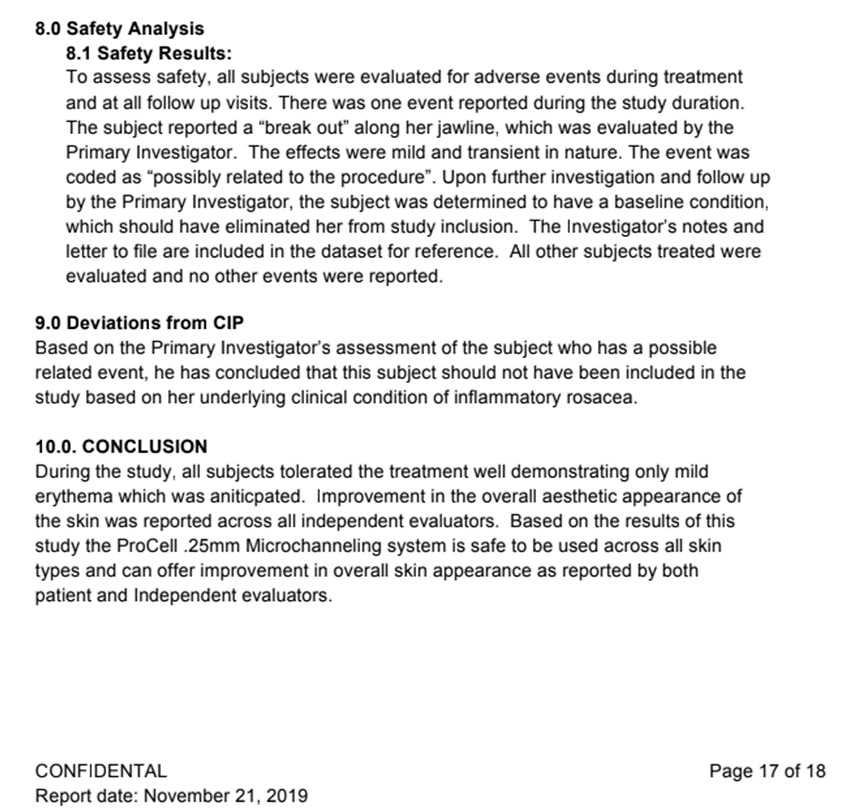
There are no results presented in the paper, only a conclusion. Yes, that’s right. No results are presented. What they do present in their “Safety Analysis” is a set on incongruous statements about how one patient was injured. Here’s what they reported in their “Safety Analysis”:

8.0 Safety Analysis
8.1 Safety Results:
To assess safety, all subjects were evaluated for adverse events during treatment and at all follow up visits. There was one event reported during the study duration.
The subject reported a “break out” along her jawline, which was evaluated by the
Primary Investigator. The effects were mild and transient in nature. The event was
coded as “possibly related to the procedure”. Upon further investigation and follow up
by the Primary Investigator, the subject was determined to have a baseline condition,
which should have eliminated her from study inclusion.
 The Investigator’s notes and
letter to file are included in the dataset for reference. All other subjects treated were
evaluated and no other events were reported.

My comment: (here they’re saying one of the patients had an adverse reaction)

9.0 Deviations from CIP
Based on the Primary Investigator’s assessment of the subject who has a possible
related event, he has concluded that this subject should not have been included in the
study based on her underlying clinical condition of inflammatory rosacea.

My comment: (here they’re saying the physician screwed up and shouldn’t have included this patient in the study)

10.0. CONCLUSION
During the study, all subjects tolerated the treatment well demonstrating only mild
erythema which was aniticpated [sic].
 Improvement in the overall aesthetic appearance of
the skin was reported across all independent evaluators. Based on the results of this
study the ProCell .25mm Microchanneling system is safe to be used across all skin
types
 and can offer improvement in overall skin appearance as reported by both
patient and Independent evaluators.

My Comment: (here they contradict themselves, saying that the procedure is good for all skin types)

Here’s an image from the study so you can see for yourself:
Combine this inflammatory-proliferative, injurious procedure with the bone marrow mesenchymal stem cell cytokines that they sell, and one has set themselves up for adverse events, possibly long-term. There are skin conditions for which microneedling, when not performed repeatedly, is beneficial and the benefits out way the risks. Acne scarring and other types of scars can be an example. To quell the inflammation associated with the procedure and to set the immune system into a anti-inflammatory, pro-repair state, use the S2RM technology, found to be safe and efficacious, contained in Neogenesis Recovery.

Skin Cell Renewal and Collagen Production Without Injury

Wounding from procedures induces cellular replication, and replication may drive changes in cells and could push them toward a more tumorigenic state. “Tumors are wounds that don’t heal.”

Tissue specific stem and progenitor cells, such as the skin’s mesenchymal stem cells, fibroblasts, and keratinocytes, can persist during the lifetime or for extended periods of time in humans and contribute to both renewal and repair by giving rise to pools of progenitor cells that persist for various periods of time, replenish differentiated, i.e. mature cells, release many types of molecules involved in healing, and make short-term contribution to wound healing. Normally, these cell’s processes maintain and heal our skin throughout life. However, due to poor lifestyle, such as a diet that overfeeds us but under nourishes us, the nutrients needed to maintain proper function in these cells are lacking. Too much sun, leave-on products that are pro-inflammatory, and environmental exposures are other examples of lifestyle factors diminishing skin function. While hereditary and genetic factors may play a role, their contribution is minimal to developing diseases. Along with intrinsic aging, where our cells go through “wear and tear” to maintain themselves regardless of other impinging factors, what we do in life, i.e. our exposome is by far the most significant factor in maintaining health, including our skin health. Again, our exposome as a consequence of what we do in life, is the largest factor in our skin’s health. For example, if you don’t exercise, then the body won’t produce a normal complement of antioxidants. And, if you don’t eat a sufficient supply of fruits and vegetables, antioxidants will not be carried through the blood and pumped into the skin. And if you’ve induced chronic inflammation in the skin, perhaps through the continuous use of an inflammatory product or procedure, then the antioxidants and other nutrient may not be efficiently pumped from the blood supply into the skin. Yes, inflammation can interfere with the pumps in the blood vessels that bring nutrients from the blood supply into the skin.

As I have written, numerous studies have found that providing all the necessary nutrients, without an overabundance of calories, optimizes stem cell function in the body. Eating well also optimizes the cell function in cells other than stem cells, many of which act to support stem cell function. It’s all a tightly woven system, and the key here is to understand it’s a system. All of our cells work together. For example, even inflammation in the outer layers of the skin, the epidermis, leads to inflammation throughout the body. So what you do to your skin affects your whole body. If you’re using topical products that induce inflammation in the skin, you’re inducing inflammation in the body. If you’re having a procedure, such as laser, chemical peels or microneedling, you’re inducing inflammation in the skin and therefore inflammation in the body. As I have previously written, wounding the skin through the use of these procedures, induces not only inflammation, but proliferation too. This over-driving of cell proliferation leads to cellular exhaustion. Stem cell exhaustion or dysfunction increases with age, and especially with too many wounding procedures, and impedes the normal function of multiple tissues and systems. Dr. Leonard Hayflick, Ph.D., a professor at UCSF, discovered that cultured normal human cells have limited capacity to divide, after which they become senescent and can secrete inflammatory factors, a phenomenon now known as the ‘Hayflick limit’.  Increase inflammation and/or increase proliferation, and you can drive cells towards their Hayflick Limit. That’s what too many wounding procedures can do to the skin. Further, chronic inflammation coupled with chronic proliferation of cells is a hallmark of cancer.

If you are having one of these wounding procedures, something that can induce prolonged inflammation, I recommend using a product, such as NeoGenesis Recovery, that quells inflammation. Here’s why I recommend Recovery: Stem cell released molecules from adult stem cells derived from the skin are the key ingredient in Recovery. These molecules, the so-called S2RM technology, powerfully quell inflammation and reset the immune system from one of inflammation to one of anti-inflammation and pro-repair. The results are dramatic, and inflammation is quickly reduced. And because healing is hastened, proliferation is reduced too. Too much proliferation of the cells in the skin can lead to cellular exhaustion, senescence, and aging of the tissue. So key to healthy skin, particularly while we’re aging, is to control inflammation and, importantly, control the damage to the skin. Too many procedures that wound the skin, will lead to eventual aging of the skin. Thus, one may see short term positive effects, but long term negative consequences.

So how does one induce modest amounts of cellular turnover to remediate skin problems such as lines and wrinkles, sagging, and discoloration? The key is evolutionary science. How does mother nature naturally keep the skin healthy and keep the cells turning-over at a safe rate? The key is feeding the skin: from the inside-out through diet, and from outside-in through topical application of carefully chosen products. And what you feed the skin is critical. There is no magic bullet, not one ingredient alone that will yield the desired results. Rather, the skin is a system, composed of many different elements, each element depending on its own set of needs. So to feed the skin, many different ingredients are needed. For example, Vitamin C is needed as an antioxidant and also to induce the production of collagen as well as to facilitate the post-translational modification of the collagen protein that has been produced. There are other functions of Vitamin C in the skin as well. Many other antioxidants are present in the skin, and they work synergistically. To optimize the antioxidant capacity of the skin, and not to have too much of one thing, many antioxidants need to be fed to the skin. Too much of one can have disastrous results. Consider Vitamin E. Tocopherol and its esters are some of the most well described antioxidants and they are commonly used for their ability to minimize ultraviolet damage. However, overuse of Vitamin E can inhibit glutathione-S-transferase, responsible for the removal of cytotoxic compounds related to tumorigenesis in the skin. And if too much Vitamin C is present, then oxidative oxygen radicals are formed through interactions with other molecules in the tissue. The consequences of this Vitamin C overload and the production of oxidants is yet to be adequately described.

The bottom line is to use a combination of ingredients that are natural to the skin, and not overload on a single or just a few ingredients. This is the scientifically-based strategy that I use when formulating products for NeoGenesis. I use Vitamin C in some of our products to help in the natural production of collagen turmover and to repair those collagen fibrils that will be present for years to come. Some collagen protein is called long-lived protein and will remain in the skin for decades. It can accumulate damage over the years, and one way to protect it and repair it is with the use of multiple types of antioxidants. Therefore, when I formulate products, Neogenesis offers multiple types of antioxidants that work synergistically. Sometimes people ask me, why do the Neogenesis products have different colors, and why aren’t they all white and creamy like other products on the market? The simple answer, our products have a multitude of ingredients that are important to the skin and have different colors. Think about your diet. If everything you ate was white, you die pretty quickly from malnutrition because you’re not eating all of those colorful fruits and vegetables that provide colorful nutrients to the body. All of these ingredients are necessary for the natural turnover and repair of your skin’s cells. Mother nature gives you a balance of nutrients, and that is what we do at NeoGenesis.

At Neogenesis we offer safe and natural, mostly skin-identical, ingredients that support the natural turnover of the skin’s cells. Skin identical ingredients include the S2RM that our skin’s stem cells make and ceramide and urea that are made by other cells. Skin identical ingredients also include ingredients that our bodies don’t make, but are brought into the skin through diet, including vitamin C and carrotenoids. We don’t give you a product loaded with just one ingredient at high amounts, such as EGF so that face reddens and puffs up like a water balloon, nor do we offer a lip product loaded with gobs of peppermint oil to irritate, cause an inflammatory immune reaction, and swell the lips so that everyone looks like they have Melkersson-Rosenthal syndrome. A core technology that we use at Neogenesis is our S2RM technology. As our skin ages or is compromised by poor health and poor diet, our stem cell function can decline. The molecules that we use at NeoGenesis are from stem cells in the skin that help to induce collagen production, protect collagen, and help to control the turnover of keratinocytes in the epidermis that are key to barrier formation. So what we’re doing at NeoGenesis is simply returning to the skin what was naturally present when we were young and healthy. In this way we restore natural cellular turnover and collagen production, without the adverse side effects of inflammation and over-proliferation associated with wounding procedures. And remember, if you do have a wounding procedure, be sure to use NeoGenesis Recovery before and after the procedure to minimize inflammation, normalize proliferation, and reset the innate and adaptive immune systems of the skin to a pro-healing mode. Please avoid certain stem cell products that are made with pro-inflammatory and pro-oncogenic bone marrow mesenchymal stem cell cytokines. With the use of Recovery, better results are realized from the procedure with fewer adverse side effects and less down time.

Why I Don’t Recommend Ablative or Wounding Procedures of the Skin

Scientists appreciate that one of the most dangerous things a cell can do is to divide. That’s what happens following an ablative or wounding procedure to the skin.

I’ve previously published papers in peer-reviewed, PubMed listed journals explaining how wounds, including micro-wounding such as that caused by microneedling procedures, induces an inflammatory response in both the innate and adpative immune systems of the skin. Such wounding is especially problematic when performed repeatedly and when bone marrow mesenchymal stem cell cytokines are applied to the wound. Even with a properly performed procedure, without infection, sterile inflammation results. And as repeated wounding procedures result in chronic inflammation, oncogenic potential is increased. Cancer has been described as wounds that do not heal.

But wounding is more than inflammation. To close the wound and remodel the damaged tissue, many cells proliferate. That means they may grow in size, and importantly, replicate themselves. So when you have an ablative or wounding procedure performed on the skin, proliferation of cells will result. This happens following acid peels, laser treatments, microneedling and other procedures that wound the skin.

So what’s wrong with proliferation of cells? Let me give you a hint. Carcinomas arise from epithelial tissue and account for as many as 90 percent of all human cancers. Why so many cancer in epithelial tissue? Because epithelial cells, including some of the cells in the skin, have high rates of proliferation. When cells proliferate, replicating themselves, they must make a whole new set of DNA. During the replication of DNA, many errors are made. Mutations result. To maintain the normal processes of the genome throughout cell function and division, we have evolved a complex network of machinery known as the DNA damage response (DDR). At least 605 proteins organized in a hierarchy of 109 assemblies is involved in maintaining our DNA. It’s complicated and doesn’t work perfectly. According to the National Cancer Institute, “Each time a cell divides, it must first duplicate its genetic material in a process called DNA replication. Because defects in this process can cause mutations that eventually lead[s] to cancer.” One problem is that DNA replication errors, especially those occurring at regions that are hard to replicate, called fragile sites, can cause breaks in the DNA strands. This can increase the probability of cancer, primarily by making it more likely that fragments of chromosomes rearrange themselves, activating genetic regions in the DNA that lead to uncontrollable cell division. The more you wound the skin, the higher the probability of inducing such mutations and breaks in the DNA strands, and the higher the probability of cancer induction. The other cancer causing factor in wounds is that the cellular matrix and microenvironment in the skin are disrupted, and this has a profound influence on increasing the chances of cancer. This was taught to me many years ago by one of our professors, Dr. Mina Bissell, Ph.D., in the Dept of Molecular and Cell Biology at Berkeley.

So wounding in the skin, especially when repetitive, such has been promulgated by non-dermatologist physicians, such as John Sanderson, who lost his license to practice medicine because of incompetence, and Lance Setterfield in their blogs and books, who call for repetitive microneedling procedures for skin care, simply don’t know what they’re doing. Thanks to my pushback, of late, Mr. Setterfield (he has an undergraduate bachelor’s degree in medicine) has toned down his call for repetitive microneedling. I hope he stops promoting dangerous bone marrow mesenchymal stem cell cytokines too. I’ve published a number of papers on the problems associated with the use of these cells, even under the most stringent conditions where the cells are used for transplantation at hospitals for blood diseases.

Other physicians, such as Mitchel Schwartz have now joined in to the microneedling craze for the sake of money, and are selling automated microneedle stamping machines to whomever wants one. Schwartz claims his device doesn’t create damage or inflammation because the needles don’t roll over the skin at an obtuse angle, but are stamped, perpendicularly, into the skin. Utter BS. His device is electronically stamping thousands of wounds into the face, and generating an immune reaction in the epidermis and dermis, leading to inflammation in the skin and inflammation throughout the body. Schwartz is even selling these devices to estheticians in California where the state’s laws forbid such procedures to be performed by estheticians. Damn the laws and damn the inflammation and cancer, there’s money to be made by selling microneedling to everyone. And some physicians love their side hustles.