Stem Cell Aging and Loss of Tissue Maintenance Because of Inflammaging

Early and mid-life inflammation ia a mediator of lifelong defects in tissue maintenance and regeneration due to the inflammation aging the stem cells. Inflammation damages the extracellular matrix, DNA, and epigenetic mechanisms, all of which contribute to aging and age-related diseases.

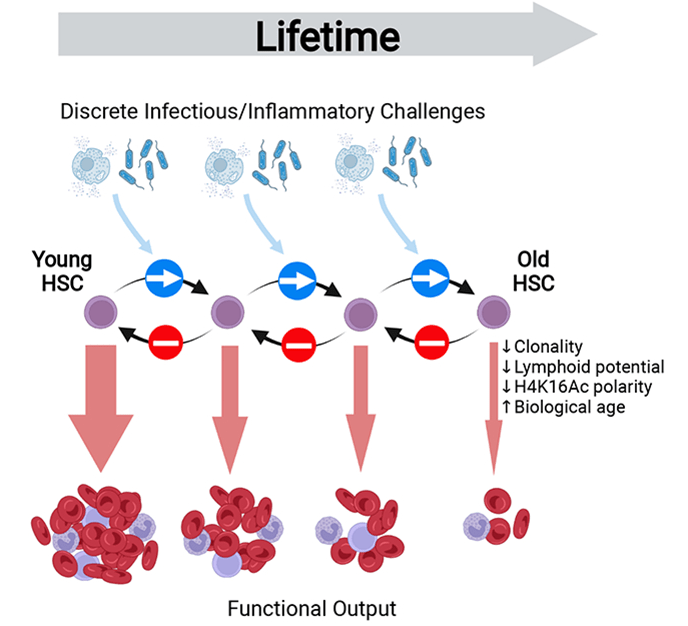
A schematic of stem cell inflammaging (from Bogeska et al, 2022)

Inflammaging, defined as an age-related increase in the levels of pro-inflammatory markers in blood and tissues, is a strong risk factor for multiple diseases that are highly prevalent, and frequent causes of disabilities in elderly individuals but are pathophysiologically uncorrelated, i.e., everything from cancer, to skin diseases, to heart disease, and neurodegeneration. And remember, as I’ve discussed in previous blogs, inflammation in the skin can can lead to systemic inflammation.

Inflammation can wreak havoc on the body, including the skin, through a number of key mechanisms. Let’s have a look at how inflammation can damage tissue, such as by degrading the extracellular matrix, and can damage cells at the molecular level through genetic and epigenetic mechanisms. Genetic refers to how damage occurs to the DNA, and epigenetic refers to how damage occurs “above” the DNA, such as the mechanisms that control the expression of DNA – i.e., affecting how the DNA makes RNA and proteins. Inflammation can also cause misfolding in proteins, resulting in a number of dysfunctional pathways in the body, including the control of epigenetics such as protein-based epigenetics. You read that right – proteins can be inherited and dysfunctional proteins in an adult can be inherited as dysfunctional proteins in the offspring. That’s one reason why genetics and heredity don’t mean the same thing.

Inflammaging is a process induced by chronic inflammatory cytokine signaling that promotes accelerated damage to the extracellular matrix (ECM), stem-cell aging, and precancer stem-cell generation. Multiple different sterile and infection-associated inflammatory stimuli have been shown to provoke primitive stem cells (HSCs) to exit their long-term quiescent state and enter into active proliferation. In other words, inflammation, whether it is sterile inflammation or infection-related inflammation, drives stem cells into a state where they multiply. Therefore, chronic inflammation will induce the constant multiplication of stem cells. And every time a cell multiplies itself, mutations and consequent aging processes will occur. As I’ve said before, one of the most dangerous things a cell can do is to multiply itself. 

As scientists have recently published, their work demonstrates that inflammatory stimuli can provoke a long-lasting inhibitory effect on tissue regeneration that extends far beyond the duration of the original inflammatory event, via the progressive and irreversible attrition of the functional stem cell pool. They argue that prophylactic anti-inflammatory interventions may effectively delay or prevent the evolution of age-associated pathologies, but that such treatments may hold limited capacity to rejuvenate an already aged stem cell system. 

In other words, it is important to reduce inflammation even during our younger years, not just during our aged period, in order to reduce stem cell aging processes. This means eating a plant-forward diet, full of lots of fruits and vegetables, as well as using sunscreen during long sun exposures, as well as using skin products that are not inflammatory – rather using skin care products that reduce inflammation and those that help to maintain or build the skin’s barrier function.

Safety and Efficacy Considerations of Stem Cell Technologies for Skin Care: : ADSCs preferred Over BMSCs

Mesenchymal Stem Cells and their Progenitor Cells (Fibroblasts) Derived from Skin are Superior to Bone Marrow Derived Mesenchymal Stem Cells

When addressing safety and efficacy concerns of stem cells, we must consider tissue-specific stem cells. Choosing the appropriate stem cell type to match the condition to be treated is critical not only to efficacy, but most importantly, safety of the therapeutic. Beyond the genetic and epigenetic factors that influence stem cell phenotype as embryonic stem cells differentiate into somatic stem cells, the immediate niche of the stem cell will have profound influence on the cell’s phenotype. Therefore, the appropriate use of adipose derived mesenchymal stem cells (ADSCs), and their related progenitor cells from the skin, fibroblasts, is optimal for skin care compared to bone marrow mesenchymal stem cells (BMSCs)

Let’s consider some of the problems BMSCs pose for developing skin care products. The complexity of the bone marrow (BM) niche can lead to many stem cell phenotypes, whether we consider hematopoietic stem cells (HSCs) or bone marrow mesenchymal stem cells (BMSCs). Here I will discuss the properties of BMSCs, not HSCs. Because of the complexity, many BMSC phenotypes exist, including disease causing phenotypes that are varied and hard to distinguish – a part of the problem in using BMSC for therapeutic development. This complication, unlike that for ADSCS, includes recirculated cells, particularly recirculated cancer cells. Once a tumor cell disseminates into the BM, the cancer cell often displays phenotypic characteristics of BMSCs rendering cancer cells difficult to distinguish from BMSCs. BM is a site of BMSCs that may differentiate into HSCs and recirculating blood cells that may differentiate into BMSCs [see Cardenas et al; Tondreau et al]. BMSCs are also found outside of the niche in peripheral blood and home into sites of injury and cancer tissue where they are educated into becoming a pro-cancerous phenotype. Recirculated melanoma and myelogenous leukemia cells in BM interact with BMSCs to change the phenotype of the BMSC to one that is cancer promoting by enhancing their proliferation, migration, and invasion and altering the production of proteins involved in the regulation of the cell cycle. Indeed, melanoma tumor cells start to disseminate to BM during the initial steps of tumor development. In breast cancer patients, detection of recirculated cancer cells that disseminated in BM predicts recurrence of the cancer. Cancer cells can fuse with BMSCs and change their phenotype, or release exosomes to change the phenotype of BMSCs to cancer promoting. Indeed breast tumor cells fuse spontaneously with bone marrow mesenchymal stem cells. This fusion may facilitate the exchange of cellular material from the cancer cell to the BMSC rendering the fused cell more oncogenic. Further, others have found the same result of this fusion and exchange of cellular material, which has been found to increase metastasis. For example, Li et al found that human hepatocellular carcinoma cells with a low metastatic potential exhibit a significantly increased metastatic potential following fusion with BMSCs in vitro and in xenograft studies. This means that the BMSCs and their molecules/exosomes, having been conditioned by tumor cells, were found to increase the probability of cancer in human patients. The various phenotypes of BMSCs, including the cancerous phenotypes are difficult to distinguish. In contrast, even ADSCs derived from cancer patients have been found to be safe for therapeutic development.

One of many reasons why ADSCs are preferred compared to BMSCs is that ADSCs express a low level of major histocompatibility complex (MHC) class I molecules and do not express MHC class II and costimulatory molecules. Even the exosomes of BMSCs express MHC class II proteins. These problems in BMSCs are amplified when using donor, allogeneic BMSCs that have been replicated many times, essentially aging the cells, during expansion to develop the therapeutic. This is in contradistinction to ADSCs. Critically, when comparing experimental data of BMSCs to ADSCs from the same human donor, “ADSCs have a “younger” phenotype,” according to stem cell scientists. Indeed, Burrow et al found that BMSCs have, among other negative attributes compared to ADSCs, an increased level of senescence compared to matched ADSCs. Senescent cells develop the senescence-associated secretory phenotype (SASP), a pro-inflammatory set of molecules where the local tissue effects of a SASP or specific SASP components have been found to be involved in a wide variety of age-related pathologies in vivo such as hyperplastic diseases, including cancer. Whereas the use of BMSC transplants has a history of medical adverse events, including the induction of cancer in the recipient (Maguire, 2019), fat grafting, along with its constituent ADSCs, have a long history of safety in medical procedures dating back to 1893 when the German surgeon Gustav Neuber transplanted adipose tissue from the arm to the orbit of the eye in an autologous procedure to fill the depressed space resulting from a postinfectious scar. Fat grafting’s long history of being safe, regardless of the harvesting techniques used in patients, has been recently reviewed by physician-scientists at Baylor College of Medicine. Furthermore, physician-scientists at Stanford University School of Medicine have recently reviewed the safety and efficacy of using ADSCs to augment the outcomes of autologous fat transfers. Scientists have found that ADSCs and fat grafting for treating breast cancer-related lymphedema is safe and efficacious during a one year follow-on, where patient-reported outcomes improved significantly with time. In a randomized, comparator-controlled, single-blind, parallel-group, multicenter study in which patients with diabetic foot ulcers were recruited consecutively from four centers, ADSCs in a hydrogel was compared to hydrogel control. Complete wound closure was achieved for 73% in the treatment group and 47% in the control group at week 8. Complete wound closure was achieved for 82% in the treatment group and 53% in the control group at week 12. The Kaplan–Meier (a non-parametric statistic used for small samples or for data without a normal distribution) median times to complete closure were 28.5 and 63.0 days for the treatment group and the control group, respectively. Treatment of patients undergoing radiotherapy with adult ADSCs from lipoaspirate were followed for 31 months and patients with “otherwise untreatable patients exhibiting initial irreversible functional damage” were found to have systematic improvement or remission of symptoms in all of those evaluated. In animal models with a full thickness skin wound, administration of ADSCs, either intravenously, intramuscularly, or topically, accelerates wound healing, with more rapid reepithelialization and increased granulation tissue formation, and topically applied the ADSCs improved skin wound healing by reducing inflammation through the induction of macrophage polarization from a pro-inflammatory (M1) to a pro-repair (M2) phenotype.

All in all, companies using BMSCs to develop their skin care products demonstrates a profound ignorance of the related science. Incompetence, and a greedy, lazy approach to serving the skin care market is demonstrated by those using bone marrow stem cells to develop skin care products that potentially damage their clients.

NeoGenesis S2RM Technology

Stem cells in the skin are cells that self-renew themselves, so that they are always present in the skin. While stem cells in the skin can generate other cell types, their most important function is to continuously release molecules into the skin. Many types of molecules are released into the skin by the stem cells, the function of which is to maintain and heal the skin throughout our lives.

NeoGenesis’ S2RM technology uses all the different molecules from stem cells derived from the skin, instead of just one or a couple of molecules. S2RM technology therefore targets multiple pathways underlying a disease or condition, not just one or a few pathways as used in previous therapeutic designs. The condition, for example, can be aging, where the pathways in the skin are not working as well as they once did when the skin was young. The multiple molecules renormalize the multiple pathways and thus renormalize the physiology of the skin. For aging skin, this means the pathways are now working more like they did when we were younger. Simply put, diseases and conditions of the skin have many unique abnormal pathways that underlie the condition, and each unique pathway must be renormalized using many molecule types, each of which acts at one of the many abnormal pathways underlying the disease or condition.

Specifically, NeoGenesis uses proprietary and patented adult stem cell released molecules in its safe and effective core technology. The molecules are released, not extracted, from 3 or more types of adult stem cells derived from the skin to make our products. Using released, not extracted, molecules assures that the molecules are fully formed in their natural state and therefore effective, and naturally packaged into a protection and penetration liposome-like structure called the exosome. The exosome is like a tiny capsule, such as that used to encapsulate drugs. However, unlike the capsule, mother nature has designed the exosome to be smart. It has special structures that allow it to easily penetrate the skin and deliver the molecules where they are needed. Further, we don’t use immortalized cells that may secrete pro-oncogenic signals in their exosomes, and may also produce exosomes with an altered content, rendering them less efficacious.

Adult stem cells are partially differentiated stem cells, not embryonic stem cells. This means that the adult stem cells used by NG are more mature than embryonic stem cells, which are cells that can make any cell in the body. The adult stem cells are lineage restricted, meaning that the stem cells we use that are derived from the skin only make skin cells. Skin specific adult stem cells developed in the skin to specifically and effectively maintain and heal the skin. Because adult stem cells are tissue specific, stem cells derived from the skin work better than other types of stem cells from other parts of the body in their effectiveness to maintain and heal the skin. For example, adult stem cells derived from bone marrow don’t work well in the skin.

Key to how adult stem cells work before they differentiate into mature skin cell types is that the adult stem cells reside in the skin to maintain and heal the skin, doing so by releasing building block molecules such as collagen and laminin, and instruction set molecules, such as HAPLN-1, that signal the building block molecules how to organize. Molecules, such as HAPLN-1, decrease in concentration as we age, and as a result diseases, such as melanoma, will occur with a greater probability. From the work of Dr. Ashani T. Weeraratna, Ph.D. at Johns Hopkins, we know that supplying HAPLN-1 to aged skin can reverse this effect, and renormalize the matrix and lymphatic system in the aged skin. As she has pointed out, normal matrix in the skin is vital to good health and keeping skin cancer at bay. This follows the pioneering work by Dr. Mina Bissell, Ph.D. at Berkeley, who taught us all how critical the matrix is to cancer formation, and as I have pointed out, to many other diseases.

The NeoGenesis S2RM technology is a combination of adult stem cells of different ages where younger adult stem cells are used to make the building block molecules for scar-free healing, and slightly older stem cells make the instruction set molecules so that normal, adult skin architecture is maintained or reformed after injury. The molecules in S2RM also include those that calm inflammation and help to reset our skin’s immune system to help repair the skin. Other molecule types are present that repair damaged proteins in the skin, while other molecules prevent and repair damage to protein, lipids, and DNA.

Because we use multiple skin stem cell types, from which we collect all the molecules released, NeoGenesis’ S2RM is the most advanced skin technology available in today’s skin care market.

S2RM Contains Protein, Lipids, Micro-RNA, and No DNA.

The stem cell released molecules that NeoGenesis uses in our S2RM technology is a mixture of proteins, micro-RNA and lipids that is from skin derived mesenchymal stem and progenitor cells. This technology is a new means for therapeutic development. The molecules that are released from the different stem cell types are largely packaged into exosomes. Exosomes under 150 nm in diameter do not contain DNA, whereas larger extracellular vesicles (EVs) can contain small amounts of DNA. Exosomes are made by cells in different process than the way EVs are made. As with other studies characterizing vesicles secreted from mesenchymal stem cells, we have found the size of the exosomes (small extracellular vesicles) to about 50-80nm in diameter. Again, these exosomes have not been found to contain DNA. At NeoGenesis, we also use filtration methods in the production of the S2RM that would prevent large EVs from entering our S2RM. As stated by Rani et al (2015), “the fundamental basis for MSC-EV therapeutic effects lies in their ability to transmit biological information—in the form of proteins, glycoproteins, lipids, and ribonucleic acids—from stem cells to injured cells.” This is an important part of the exosomal S2RM technology, but there is more. The S2RM is also, 1. immune modulating to bias towards tissue repair and away from inflammation, 2. supplies important building blocks for tissue repair, such as collagen, 3. many types of antioxidants to help repair and protect proteins, DNA, and lipids, and 4. supplies proteosomes to carry away damaged cells for recycling. Attributes one through four are in addition to the repair properties of the S2RM that include growth factors, and heat shock proteins to repair proteins and DNA. Important to note is that the exosomes work in concert with soluble proteins to repair tissue – it’s not just the exosomes. This is why NeoGenesis uses the exosomes and the soluble proteins (the fraction of proteins not contained in the exosomes) in our S2RM technology. – we don’t through away the good and synergistic part of what stem cells release, a fraction of the S2RM that contains many proteins, including heat shock proteins. The fraction not contained in exosomes also contains many important signaling lipids that reduce inflammation, such as PEA, and that build the extracellular matrix. And it’s also important to note the cells we use from the skin are superior in this regard, and may others ways too, than the mesenchymal stem cells from bone marrow.

Conditioned Media and Exosomes: Stem Cell Released Molecules Journey From Topical Application to the Dermis

Recent studies have found that the conditioned media from skin-derived adipose mesenchymal stem cells (CM-ADMC) penetrate intact human skin and induce wound healing when topically applied. Exosomes are one mechanism by which the molecules penetrate the skin. Likewise, in animal models, CM-ADMC reduces inflammation and promotes wound healing when topically applied to intact skin.

I’ve developed products from the molecules that stem cells release (Maguire, 2013) that can be topically applied to have effects in the epidermis and dermis. This penetration of the molecules means that even the stratum corneum and the tight junctions in the epidermis are not barriers to the stem cell released molecules (SRM). We have much evidence for how these topically applied molecules penetrate and act throughout the skin’s layers to provide many benefits.

In the 1990s when I was a professor at the University of California, San Diego we were using a type of stem-cell genetically modified in order to have a living cell constituently secrete Nerve Growth Factor (NGF) into degenerating neural tissue to rescue the neurons and other cells from dying. In the process of studying the genetically modified cells, we discovered that the control stem cells that were not genetically modified to secrete NGF were working as well or better than the genetically modified fibroblast.  I realized that normal stem cells were releasing numerous molecules to repair and prevent neural degeneration, and that was an epiphanic moment for me – that we could use stem cells as cellular factories to produce these beneficial molecules. And this meant that if you use the stem cells to produce the molecules in the laboratory, you wouldn’t have to inject or otherwise administer stem cells themselves to the tissue. Rather you could culture and stimulate the stem cells in the laboratory to optimize the output of the molecules that the stem cells release for maximum therapeutic benefit. Many studies in the ensuing years have provided evidence that it is the release of molecules from stem cells that provide most of the stem cell’s therapeutic benefit.  Using the molecules themselves without the cells as a therapeutic is much easier and more straightforward, and more efficacious than injecting or administering stem cells to the patient where we don’t know the number of stem cells accruing in the injured area and where we don’t know if the stem cells are working correctly. That is, one doesn’t know if the cells are making and releasing the molecules into the injured area. Whereas, using the molecules means that you apply a defined, optimal dose of molecules directly to the injured tissue. Importantly, the molecules released from the stem cells, and not molecules artificially extracted from the stem cells, are critical for two key reasons. First, the molecules need to be fully formed for them to work properly, and it is the released molecules, not extracted molecules, that are fully formed. Not waiting for the molecules to be released means that extracted molecules may not have fully formed and may be misfolded, causing them to be ineffective and potentially dangerous. Second, the released molecules are packed into exosomes that are natural protection and penetration devices for the released molecules. Extracted molecules are not packaged into the exosomes.

Back in the 1990s and into the early 2000s stem cell therapeutics was mainly focused on embryonic stem cells. Embryonic stem cells were all the rage because those cells could fully differentiate, that is turn into or transform themselves into almost any cell type in the body. The idea was to use embryonic stem cells to make new tissues. The thought of using adult stem cells was carried forth by only a few of us during that time, and funding was tight for anything other than embryonic stem cells. The adult stem cells could not turn into any tissue in the body and had limited potential to differentiate into other cell types – and this was an anathema to academia as well as the investment community. Adult stem cells are tissue specific and have restricted lineage fates. Instead of developing an organism, as embryonic stem cells do, adult stem cells have partially matured (differentiated) into a phenotype that is used by a particular tissue to maintain and heal itself. The adult stem cells found in our tissues have evolved to maintain and heal our tissues, doing so mainly through the release of molecules (Maguire, 2013). At the time, when I proposed not only using adult stem cells as a therapeutic but also using just the molecules released from adult stem cells, there was little interest and sometimes downright bashing of my proposal. Despite zeitgeist focusing on embryonic stem cells, in the 1990s we began to use the stem cell released technology for repairing brain tissue (Maguire et al, 2019). Because we had been using genetically modified adult stem cells derived from the skin to begin our studies of repairing the brain, we realized that using these adult stem cells from skin might be used to heal the skin. This would yield proof of concept safety and efficacy studies that were less expensive and more quickly accomplished than having to deliver the molecules into the brain and measure the results in an organ that is much less accessible than the skin. This is how I began studying skin. The more I looked at the skin, the more fascinated I became, especially given we began to see very encouraging results using the molecules to heal wounds. With a beautiful, layered structure, constant turnover of stem cells, such as the keratinocytes, and powerful innate and adaptive immune systems, studying the skin became a labor of love. When we were injecting these molecules into the brain, it was easy to understand how they penetrated through the tissue. But when we began working on the skin, and the molecules were not only working in wounded skin with a degraded barrier, but were also working on intact skin with a normal barrier – we were surprised. I was taught, and indeed I taught my students that these large proteins we were working with would not penetrate skin barriers.

But the molecules were penetrating intact skin. We saw it, and so did others (Kim et al, 2017). Within 3 hours following application to the skin, the exosomes are penetrating the epidermis, at 18 hours they are deep in the epidermis, and within 3 days they have begun to increase the production of collagen and elastin in the dermis. How are they penetrating the skin? The simple answer is exosomes, a liposome-like structure. But the exosomes are more complicated than liposomes and have some extra features that seem to enable them to better penetrate tissue than a liposome. While having a more flexible structure than a liposome, allowing them to squeeze through closely packed structures, the exosome also has proteases and glycosidases contained on its surface (either attached or as transmembrane proteins), as well as on its inside (Sanderson et al, 2019). Those proteases and glycosidases are known to break down barriers, including tight junctions (Lin et al, 2020) and matrix molecules that would otherwise prevent the exosome’s penetration through that part of the tissue. So as the naturally flexible exosome is squeezing through structures in the skin, the proteases and glycosidases are temporarily breaking punctate structures that prevent their penetration. We now understand that cells in the skin use exosomes to send their signals to other cells (Cicero et al, 2015; Nasiri et al, 2020), including to directly modify immune cells (Zhou et al, 2020), and that these stem cell derived exosomes can be safely used for skin therapy (Maguire and Friedman, 2020). Work continues to further develop these technologies – stay tuned.

References

Kim YJ, Yoo SM, Park HH, Lim HJ, Kim YL, Lee S, Seo KW, Kang KS. Exosomes derived from human umbilical cord blood mesenchymal stem cells stimulates rejuvenation of human skin. Biochem Biophys Res Commun. 2017 Nov 18;493(2):1102-1108.

Lin Y et al (2020) Exosomes derived from HeLa cells break down vascular integrity by triggering endoplasmic reticulum stress in endothelial cells, Journal of Extracellular Vesicles, 9:1.

Cicero, A., Delevoye, C., Gilles-Marsens, F. et al. (2015) Exosomes released by keratinocytes modulate melanocyte pigmentation. Nat Commun 6, 7506.

Maguire G. Stem cell therapy without the cells. Commun Integr Biol. 2013 Nov 1;6(6):e26631. doi: 10.4161/cib.26631. 

Maguire G, Friedman P. (2020) The safety of a therapeutic product composed of a combination of stem cell released molecules from adipose mesenchymal stem cells and fibroblasts. Future Sci OA. 6(7):FSO592.

Nasiri, G., Azarpira, N., Alizadeh, A. et al. (2020) Shedding light on the role of keratinocyte-derived extracellular vesicles on skin-homing cells. Stem Cell Res Ther 11, 421..

Sanderson RD, Bandari SK, Vlodavsky I. Proteases and glycosidases on the surface of exosomes: Newly discovered mechanisms for extracellular remodeling. Matrix Biol. 2019 Jan;75-76:160-169.

Zhou X et al (2020) Exosome-Mediated Crosstalk between Keratinocytes and Macrophages in Cutaneous Wound Healing. ACS Nano: 14, 10, 12732–12748