Conditioned Media and Exosomes: Stem Cell Released Molecules Journey From Topical Application to the Dermis

Recent studies have found that the conditioned media from skin-derived adipose mesenchymal stem cells (CM-ADMC) penetrate intact human skin and induce wound healing when topically applied. Exosomes are one mechanism by which the molecules penetrate the skin. Likewise, in animal models, CM-ADMC reduces inflammation and promotes wound healing when topically applied to intact skin.

I’ve developed products from the molecules that stem cells release (Maguire, 2013) that can be topically applied to have effects in the epidermis and dermis. This penetration of the molecules means that even the stratum corneum and the tight junctions in the epidermis are not barriers to the stem cell released molecules (SRM). We have much evidence for how these topically applied molecules penetrate and act throughout the skin’s layers to provide many benefits.

In the 1990s when I was a professor at the University of California, San Diego we were using a type of stem-cell genetically modified in order to have a living cell constituently secrete Nerve Growth Factor (NGF) into degenerating neural tissue to rescue the neurons and other cells from dying. In the process of studying the genetically modified cells, we discovered that the control stem cells that were not genetically modified to secrete NGF were working as well or better than the genetically modified fibroblast.  I realized that normal stem cells were releasing numerous molecules to repair and prevent neural degeneration, and that was an epiphanic moment for me – that we could use stem cells as cellular factories to produce these beneficial molecules. And this meant that if you use the stem cells to produce the molecules in the laboratory, you wouldn’t have to inject or otherwise administer stem cells themselves to the tissue. Rather you could culture and stimulate the stem cells in the laboratory to optimize the output of the molecules that the stem cells release for maximum therapeutic benefit. Many studies in the ensuing years have provided evidence that it is the release of molecules from stem cells that provide most of the stem cell’s therapeutic benefit.  Using the molecules themselves without the cells as a therapeutic is much easier and more straightforward, and more efficacious than injecting or administering stem cells to the patient where we don’t know the number of stem cells accruing in the injured area and where we don’t know if the stem cells are working correctly. That is, one doesn’t know if the cells are making and releasing the molecules into the injured area. Whereas, using the molecules means that you apply a defined, optimal dose of molecules directly to the injured tissue. Importantly, the molecules released from the stem cells, and not molecules artificially extracted from the stem cells, are critical for two key reasons. First, the molecules need to be fully formed for them to work properly, and it is the released molecules, not extracted molecules, that are fully formed. Not waiting for the molecules to be released means that extracted molecules may not have fully formed and may be misfolded, causing them to be ineffective and potentially dangerous. Second, the released molecules are packed into exosomes that are natural protection and penetration devices for the released molecules. Extracted molecules are not packaged into the exosomes.

Back in the 1990s and into the early 2000s stem cell therapeutics was mainly focused on embryonic stem cells. Embryonic stem cells were all the rage because those cells could fully differentiate, that is turn into or transform themselves into almost any cell type in the body. The idea was to use embryonic stem cells to make new tissues. The thought of using adult stem cells was carried forth by only a few of us during that time, and funding was tight for anything other than embryonic stem cells. The adult stem cells could not turn into any tissue in the body and had limited potential to differentiate into other cell types – and this was an anathema to academia as well as the investment community. Adult stem cells are tissue specific and have restricted lineage fates. Instead of developing an organism, as embryonic stem cells do, adult stem cells have partially matured (differentiated) into a phenotype that is used by a particular tissue to maintain and heal itself. The adult stem cells found in our tissues have evolved to maintain and heal our tissues, doing so mainly through the release of molecules (Maguire, 2013). At the time, when I proposed not only using adult stem cells as a therapeutic but also using just the molecules released from adult stem cells, there was little interest and sometimes downright bashing of my proposal. Despite zeitgeist focusing on embryonic stem cells, in the 1990s we began to use the stem cell released technology for repairing brain tissue (Maguire et al, 2019). Because we had been using genetically modified adult stem cells derived from the skin to begin our studies of repairing the brain, we realized that using these adult stem cells from skin might be used to heal the skin. This would yield proof of concept safety and efficacy studies that were less expensive and more quickly accomplished than having to deliver the molecules into the brain and measure the results in an organ that is much less accessible than the skin. This is how I began studying skin. The more I looked at the skin, the more fascinated I became, especially given we began to see very encouraging results using the molecules to heal wounds. With a beautiful, layered structure, constant turnover of stem cells, such as the keratinocytes, and powerful innate and adaptive immune systems, studying the skin became a labor of love. When we were injecting these molecules into the brain, it was easy to understand how they penetrated through the tissue. But when we began working on the skin, and the molecules were not only working in wounded skin with a degraded barrier, but were also working on intact skin with a normal barrier – we were surprised. I was taught, and indeed I taught my students that these large proteins we were working with would not penetrate skin barriers.

But the molecules were penetrating intact skin. We saw it, and so did others (Kim et al, 2017). Within 3 hours following application to the skin, the exosomes are penetrating the epidermis, at 18 hours they are deep in the epidermis, and within 3 days they have begun to increase the production of collagen and elastin in the dermis. How are they penetrating the skin? The simple answer is exosomes, a liposome-like structure. But the exosomes are more complicated than liposomes and have some extra features that seem to enable them to better penetrate tissue than a liposome. While having a more flexible structure than a liposome, allowing them to squeeze through closely packed structures, the exosome also has proteases and glycosidases contained on its surface (either attached or as transmembrane proteins), as well as on its inside (Sanderson et al, 2019). Those proteases and glycosidases are known to break down barriers, including tight junctions (Lin et al, 2020) and matrix molecules that would otherwise prevent the exosome’s penetration through that part of the tissue. So as the naturally flexible exosome is squeezing through structures in the skin, the proteases and glycosidases are temporarily breaking punctate structures that prevent their penetration. We now understand that cells in the skin use exosomes to send their signals to other cells (Cicero et al, 2015; Nasiri et al, 2020), including to directly modify immune cells (Zhou et al, 2020), and that these stem cell derived exosomes can be safely used for skin therapy (Maguire and Friedman, 2020). Work continues to further develop these technologies – stay tuned.

References

Kim YJ, Yoo SM, Park HH, Lim HJ, Kim YL, Lee S, Seo KW, Kang KS. Exosomes derived from human umbilical cord blood mesenchymal stem cells stimulates rejuvenation of human skin. Biochem Biophys Res Commun. 2017 Nov 18;493(2):1102-1108.

Lin Y et al (2020) Exosomes derived from HeLa cells break down vascular integrity by triggering endoplasmic reticulum stress in endothelial cells, Journal of Extracellular Vesicles, 9:1.

Cicero, A., Delevoye, C., Gilles-Marsens, F. et al. (2015) Exosomes released by keratinocytes modulate melanocyte pigmentation. Nat Commun 6, 7506.

Maguire G. Stem cell therapy without the cells. Commun Integr Biol. 2013 Nov 1;6(6):e26631. doi: 10.4161/cib.26631. 

Maguire G, Friedman P. (2020) The safety of a therapeutic product composed of a combination of stem cell released molecules from adipose mesenchymal stem cells and fibroblasts. Future Sci OA. 6(7):FSO592.

Nasiri, G., Azarpira, N., Alizadeh, A. et al. (2020) Shedding light on the role of keratinocyte-derived extracellular vesicles on skin-homing cells. Stem Cell Res Ther 11, 421..

Sanderson RD, Bandari SK, Vlodavsky I. Proteases and glycosidases on the surface of exosomes: Newly discovered mechanisms for extracellular remodeling. Matrix Biol. 2019 Jan;75-76:160-169.

Zhou X et al (2020) Exosome-Mediated Crosstalk between Keratinocytes and Macrophages in Cutaneous Wound Healing. ACS Nano: 14, 10, 12732–12748

Why NeoGenesis is Better Than Factor Five


Unlike AntAge, a company founded and lead by a physician who lost his medical license for incompetence and developed a pro-inflammatory skin care technology based on bone marrow stem cells, Neogenesis and Factor Five use skin derived mesenchymal stem cells that are anti-inflammatory and pro-healing. Like NeoGenesis’ exosome technology, developed by a scientist with many peer-reviewed PubMed listed publications, FactorFive was also developed by a scientist who knew not to use bone marrow stem cells for production of the molecules to be used in his products. Scientists developing products is much different from a non-scientist physician who lost his license to practice medicine developing a product.

But NeoGenesis uses another stem cell type from the skin that FactorFive doesn’t use, namely dermis derived fibroblasts. Therefore, Factor Five does not use the same conditioned media as NG. They use only the molecules secreted from adipose mesenchymal stem cells, and not fibroblasts as used by NG.

Why are fibroblasts important to the skin?

Scientists have looked at extracellular matrix (ECM) produced by fibroblasts in the dermal layer of the skin and observed dramatic changes in expression levels of many ECM proteins, particularly the protein HAPLN1 (Kauer et al, 2019). Fibroblasts have been shown to influence dermal regeneration by secreting many specific ECM components (Rouselle et a; 2019). The molecules that fibroblasts release are responsible for producing most of the matrix molecules needed to build the dermis, along with the instruction set proteins that direct how the matrix molecules are ordered to construct a normal matrix without scar formation.

The same structural changes that happen in our skin with aging and cause the appearance of wrinkles are also responsible for the increased risk of metastasis in older melanoma patients. With advancing age, the network of fibers that supports our skin loses the ‘basket weave’ organization that is characteristic of younger skin and becomes more unorganized and looser. As taught to me by one of my professors at Berkeley, Dr. Mina Bissell, Ph.D., in a tumor setting, we think of the ECM matrix as a barrier that helps contain the tumor cells by inhibiting their motility while favoring infiltration of immune cells into the tumor mass (Bissell, 2007). The infiltrating immune cells then kill the cancer. In older patients, due to the loss of HAPLN1, this barrier becomes less efficient. These age-related changes also negatively affect the way immune cells, such as T-cells, enter the tumor, inhibiting the ability of T-cells to attack the cancer. Given that NG uses the molecules from fibroblasts, including HAPLN-1 and Factor Five does not, NG is better at rebuilding the dermal matrix in a normal “basket weave’ structure resulting in better remediation of lines and wrinkles, and sagging that also leads to better immune function in the skin and the prevention of cancer.

Further, the FF Regenerative Serum contains PEG, Polysorbate 20, and Fragrance. These ingredients can be pro-inflammatory, causing allergic reactions and leading to more inflammation and degradation of the dermal matrix.

References

Bissell MJ (2007) Architecture Is the Message: The role of extracellular matrix and 3-D structure in tissue-specific gene expression and breast cancer. Pezcoller Found J. (29):2-17.


Kauer A et al (2019) Remodeling of the Collagen Matrix in Aging Skin Promotes Melanoma Metastasis and Affects Immune Cell Motility. AACR Cancer Discov (2019) 9 (1): 64–81


Rousselle, P et al (2019) Extracellular matrix contribution to skin wound re-epithelialization. Matrix Biol. 75–76, 12–26.

Why Skin-Derived, Adipose Mesenchymal Stem Cell Released Molecules (NeoGenesis) Are Better Than Bone Marrow Mesenchymal Stem Cell Cytokines (AnteAge) for Post-Procedure Healing

What AnteAge Doesn’t Know and Therefore Doesn’t Tell You

Consider the stem cells used by AnteAge to make their products: Bone Marrow Mesenchymal Stem Cells (BMSCs) and the molecules they release prolong and enhance inflammation by increasing survival and function of neutrophils (Castella et al, 2011). Under hypoxic conditions, which induces the activation of TRL4, BMSCs secrete pro-inflammatory factors and decrease the polarization of macrophages from the M1 to M2 phenotype (Faulknor et al, 2017; Waterman et al, 2010). Therefore, BMSCs cultured in normal hypoxic conditions in the laboratory are secreting pro-inflammatory factors and when administered to wounded skin will induce inflammation by recruiting neutrophils and M1 type pro-inflammatory macrophages. When you put AnteAge on your skin, these are the pro-inflammatory molecules damging your skin. In contradistinction, consider the cells used by Neogenesis. The phenotype and stem cell released molecules (also called the secretome) from skin-derived adipose mesenchymal stem cells (AMSCs) are largely unaffected by prolonged hypoxia, not recruiting neutrophils (Kalinina et al, 2015), and the molecules released from AMSCs were found to better induce the effects of the anti-inflammatory M2 macrophage phenotype than the molecules released from BMSCs (Sukho et al, 2018). These results provide strong evidence that the molecules released from AMSC are more beneficial than those from BMSCs to induce appropriate wound healing processes through the shift from a pro-inflammatory state to an anti-inflammatory, pro-healing state.

These pro-inflammatory signals from BMSC cytokines are in addition to their likelihood of containing pro-oncogenic signals that are absent in AMSCs, that I have previously reviewed in multiple, peer-reviewed, National Library of Medicine journal articles (Maguire, 2019; 2021; 2022).

Why does AnteAge use these inflammatory and potentially oncogenic molecules in their products? The first clue comes from who founded the company and was its CEO for years, John Sanderson. A former physician who lost his medical license because of incompetence, repeated incompetence, and sexual misconduct with one of his patients.

Sanderson previously was a family practice physician with an undergraduate medical degree – a bachelor’s degree in medicine. Once Sanderson finished his Canadian undergraduate degree in medicine, once he passed the medical board test in the US, regulations permitted him to use the designation “M.D.” Sanderson frequently finds himself in disputes with other companies, one of which exposed that Sanderson committed domestic violence. He was not trained as a dermatologist and was not board certified. He obviously has little to no understanding of the skin’s powerful immune system, and no idea of how bone marrow mesenchymal stem cells work in the body. Upon losing his medical license, he started a company to do further harm to people by having them use products that induce inflammation and potentially cancer.

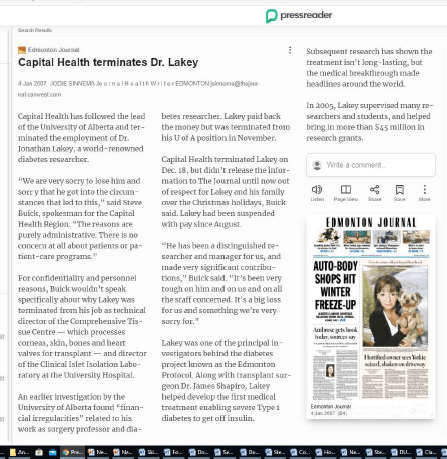
Trying to understand why a company would bring a proinflammatory, possibly pro-oncogenic product to the market, I looked closer at the company. Because John Sanderson is not a scientist, and has never listed that he has any scientific publication, only misleading blogs, I wondered how did he come to choose his technology. I discovered that Sanderson had enlisted fellow Canadian, Jonathan Lakey, Ph.D. as his scientific advisor. To no surprise, the man who had lost his medical license because of incompetence had hired a scientist, Jonathan Lakey, who had been fired from his university because of fraud.

A non-profit government organization in Canada fired Jonathan Lakey for the same reason:

Then Jonathan Lakey was charged with fraud and racketeering at one of the companies in which he was an officer:

Jonathan Lakey’s involvement with a number of other companies that are pump and dump schemes has made the news a number of times. Clearly, using a product on your skin from this dynamic fraudster-incompetence duo is a bad choice – they do not have anyone’s well being in mind.

There are other skin care companies led by physicians. I suggest if you’re interested in their products, go to the state medical board website in which they practice, and look at the current status of their medical license. For example, you can search physicians in California here, and in Colorado here. You may be surprised what you find. Simply type in their name, and you’re likely to find disiplinery actions and loss of license.

References

Castella M.A. et al (2011) Toll-like receptor-3-activated human mesenchymal stromal cells significantly prolong the survival and function of neutrophils. Stem Cells. 29:1001–1011.

Faulknor R.A. et al (2017) Hypoxia impairs mesenchymal stromal cell-induced macrophage M1 to M2. Technology. 2017;5:81–86. doi: 10.1142/S2339547817500042.

Kalinina N. et al. (2015) Characterization of secretomes provides evidence for adipose-derived mesenchymal stromal cells subtypes. Stem Cell Res. Ther. ;6:221.

Maguire G. Transplanted stem cells survive a long time: do they make you sick? J R Soc Med. 2019 Oct;112(10):412-414.

Maguire G. (2021) Stem cells part of the innate and adaptive immune systems as a therapeutic for Covid-19. Commun Integr Biol. 14(1):186-198.

Maguire G. (2022) Chronic inflammation induced by microneedling and the use of bone marrow stem cell cytokines. J Tissue Viability. 31(4):687-692.

Sukho P et al (2018) Human mesenchymal stromal cell sheets induce macrophages predominantly to an anti-inflammatory phenotype. Stem Cells Dev. 27:922–934.

Waterman R.S. et al (2010) A new mesenchymal stem cell (MSC) paradigm, polarization into a pro-inflammatory MSC1 or an immunosuppressive MSC2 phenotype. PLoS ONE. 5:e10088.

A New Means of Skin Care: Systems Therapeutic for Physiological Renormalization

Dr. Greg Maguire developed the concept of the Systems Therapeutic for Physiological Renormalization while he was a bioengineer at the University of California, Berkeley. Working and learning about biotechnology in a laboratory at Berkeley where two scientists, Dr. Don Glaser and Dr. Kary Mullis, had won Nobel Prizes and started the world’s first biotech company (Cetus Corp), Maguire’s attention would be drawn from basic biology to biotechnology. While at Berkeley, Dr. Maguire was also influenced by a colleague, Dr. James Allison, a professor of immunology who was working to renormalize the immune system in cancerous tissues. Learning how to reengage T-cells in the adaptive immune system to attack and kill cancer cells led to Dr. Allison’s being awarded the Nobel Prize in Physiology of Medicine. The current “checkpoint inhibitors” used to treat melanoma, for example, are a result of Dr. Allison’s work. This was very influential in Dr. Maguire’s approach to therapeutic development, and creating the concept of physiological renormalization. This way of thinking is in contradistinction to methodologies that, for example, knock-down the immune system such that one is now subject to infection, or hyperactivating the immune system to the point where the immune system attacks the self, destroying one’s own cells.

Maguire was later awarded a Fulbright Scholarship from the National Institutes of Health to more thoroughly develop the concepts of systems therapeutics while an associate professor in Japan. This was important because the scientific community in Japan traditionally places more value on a systems, non-reductionist, approach to healthcare and therapeutic development. In his non-reductionist approach, Maguire uses multiple molecules, instead of just one or a couple of molecules, to target multiple pathways underlying a disease or condition, not just one or a few pathways as used in previous therapeutic designs. The multiple molecules renormalize the multiple pathways and thus renormalize the physiology of the compromised tissue, such as the skin. Simply put, diseases and conditions of the skin have many unique abnormal pathways that underlie the condition, and each unique pathway must be renormalized using many molecules, each of which acts at one of the many abnormal pathways underlying the disease or condition. This new means of developing therapeutics has been accepted by the Medicinal Chemistry Section of the American Chemical Society, and has been published many times in peer reviewed, National Library of Medicine listed scientific journals. Dr. Maguire explains in his book, “Adult Stem Cell Released Molecules: A Paradigm Shift to Systems Therapeutics,” the origins and details of his approach to therapeutic development. One aspect of the Systems Therapeutics for Physiological Renormalization approach to skin care is the use of stem cell released molecules from adult stem cells derived from the skin. Dr. Maguire first developed this technology while a professor at the University of California, San Diego School of Medicine, and has demonstrated the safety and efficacy of this approach, detailed some of the mechanisms of action, and published clinical studies of how well this technology works for skin conditions. In this blog, Dr. Maguire will be discussing how to best care for skin based on an analysis of the science and technology currently available for skin care therapeutics. You will come to understand that, for example, the choice of stem cell type to derive the molecules is critical; that tissue specific stem cells, first described by Dr. Elly Tanaka at the Max Planck Institute in Germany, are critical to optimal healing, where skin derived stem cells (SDSCs) are used to treat the skin; and that some stem cell types, such as bone marrow mesenchymal stem cells (BMSCs) may be inflammatory and oncogenic because of recirculating inflammatory T-cells and cancer cells that interact with and negatively transform the BMSCs within the bone marrow. We shall see that stem cell released molecules from skin-derived stem cells are critical to optimal skin care, and that many other molecules in combination with stem cell released molecules provide optimal benefit to the skin, including for aged skin, wound healing, and various inflammatory skin conditions, including autoimmune conditions.