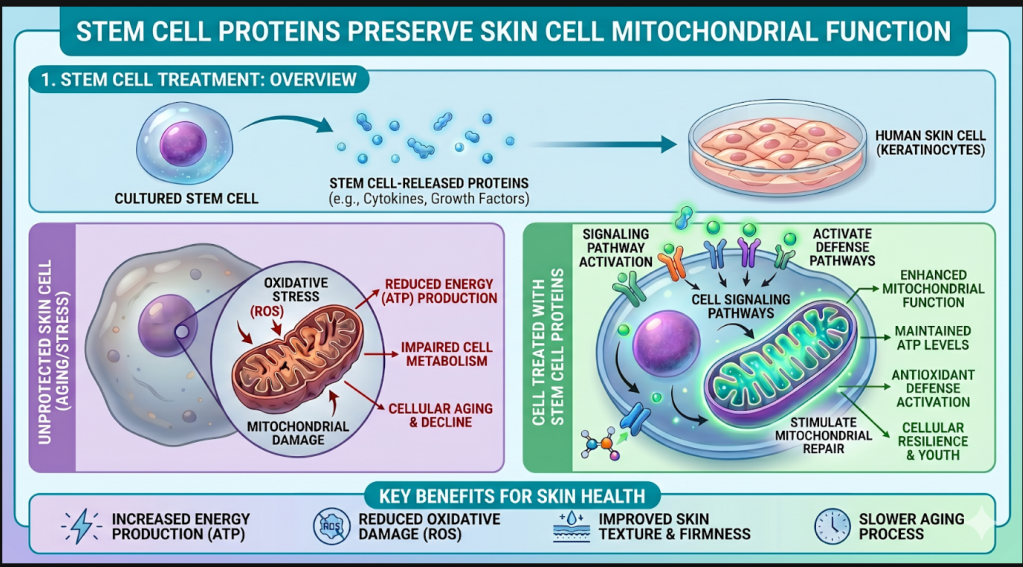
While serving as a professor and research scientist at UC San Diego and UC Berkeley, Dr. Greg Maguire began studying skin-derived stem cells for their potential to support neural tissue repair. He found that it was the molecules these stem cells released (secretome) — not the cells themselves — that drove the effect. That discovery set him on a new path: translating this molecular secretome technology into skin care that could benefit people with a wide range of skin concerns.
While Dr. Maguire focused on advancing the science, he partnered with Steve McGee, who leads the business side, and together they founded NeoGenesis. Their goal was to bring this stem cell-derived technology to market — and it has since reached thousands of people who use this new category of skin care.
From skin complications following cancer treatment to everyday skin longevity, Dr. Maguire’s discovery has shifted skin care’s focus from cover-up beauty to functional, restorative beauty. Healthy skin is beautiful skin.
Harnessing and mimicking the skin’s innate, adaptive ability to detect, process, and respond to environmental stimuli and internal signals to maintain its optimal condition.
Science-backed efficacy and safety, sensorial experiences, and natural, skin-identical ingredients are core to NeoGenesis’ technology. Ours is a holistic approach, a systems-therapeutic (Maguire, 2014) approach to skin care, using multifunctional ingredients and products that address both physical appearance and underlying health. Healthy skin is beautiful skin. Dr. Maguire’s revolutionary approach at NeoGenesis is explained in his academic book, “Adult Stem Cell Released Molecules: A Paradigm Shift to Systems Therapeutics” (Nova Science Publishers, 2018); his popular book, Thinking and Eating For Two: The Science of Using Systems 1 and 2 Thinking to Nourish Self and Symbionts (Amazon, 2020), and has garnered interest for years by those in the skin care industry.
Aesthetic treatments have become increasingly destigmatized, as skin experts and influencers sharing these interventions online becomes the norm. These treatments once exclusive to the clinic are now reshaping expectations at home, as demand grows for powerful at-home alternatives delivering visible results – winning on time, budget, ease of use, and of course results. But this shift isn’t just about DIY. It’s about medical-like performance without the costs and negative side-effects. Ingredients mimicking the mechanisms and outcomes of aesthetic procedures are gaining traction — offering smoother, firmer, more volumized skin without a needle in sight. And with nutrition, including caloric restriction, being top of mind, consumers increasingly seek safer, accessible alternatives to GLP-1 medications that mirror or improve their benefits. The result? Skin care that goes beyond hydration, cover-up, or smoothing. NeoGenesis performs like a procedure – delivering clinic-coded results, at home. Those using GLP-1 agonists, for example, will benefit from using NeoGenesis Recovery to remediate the negative consequences of the GLP-1 agonists on the fibroblast and ADSCs in the skin.
Longevity
Longevity has emerged as a central focus in health and beauty, as consumers increasingly seek ways to biohack their bodies for long-term results. This shift from traditional anti-ageing toward a lifespan- and healthspan-driven approach focuses on biological age and prolonging skin life at the cellular and tissue levels, for example, fibroblasts and the extracellular matrix —addressing the root causes of aging. At the same time, the longevity culture strives in lifestyle changes to achieve a healthy mindset and appearance. In line with this trend, the biohacking industry is gaining momentum and can become more accessible due to the “information age.” NeoGenesis is an important part of skin “biohacking,” in the best sense of the word by bridging science, technology, and self-optimization.
Biohacking can include stem cell released molecules (S2RM or S3RM) applied to the skin yielding renewed and optimized mitochondrial function (picture from Kevin Wiener).
Dr. Greg Maguire, Ph.D. – NeoGenesis Cofounder – Top 2% of Scientists
Dr. Greg Maguire of NeoGenesis has a long history in physiology and functional medicine (Maguire, 2013), and his methods for biohacking (Maguire, 2020) are helping to shape a new, performance-driven vision of long-term skin and body care. Whether it’s secretome and exosome technology, naturally sourced skin-identical nutrients as ingredients, or microbiome renormalization using prebiotics, probiotics, and postbiotics (Maguire and Maguire, 2017; 2019), Maguire has introduced these concepts and technologies to skin care.
Dr. Greg Maguire is one of the world’s leading scientists, having an H-index of 41. An H-index of 41 places a researcher in the top 2% of most-cited scientists globally. While precise percentiles fluctuate by field and database, this score is consistently categorized as “outstanding” and is indicative of a scholar at the highest levels of academia.
Web of Science for Dr. Greg Maguire, H-index = 41, placing Dr. Maguire in the top 2% of scientists world-wide.
NeoGenesis is pioneer in science-based dermohacking and continues to harness this disruptive vision by bridging longevity science, nature, and premium skin care experiences to push the boundaries of efficacy, safety, and sustainability. Not only efficacy, but safety is key to optimal biohacking and the NeoGenesis technologies, including our S2RM®-core technology, have extensive, peer-reviewed safety studies backing it (Maguire and Friedman, 2020).
With the technologies developed by Dr. Greg Maguire, the products formulated by Dr. Greg Maguire, Dr. Maguire’s patented S2RM technology produced by the NeoGenesis labs led by Linda Green, who has 30 years’ experience as a biotechnologist, lab-director at the University of Florida, and all of our products made in the NeoGenesis laboratories under the direction of Kevin Wiener, a science-grad from the University of California, Santa Cruz. NeoGenesis uses Just-In-Time manufacturing of our ingredients and products to bring the market the freshest, most innovative, and most powerful, efficacious products available.
Whether it’s skin-identical molecules to those produced in the skin by multiple skin stem cell types (S2RM and S3RM technology), the lipids produced in the skin (Triple Lipid Technology), or the dietary botanical-derived ingredients that are brought to the skin through the blood supply (Vibrant C Serum and Skin Restore Serum Vitamin A), NeoGenesis provides the full spectrum of ingredients needed to return the skin to a healthy state and optimize skin longevity.
References
Maguire G. (2013) Stem cell therapy without the cells. Commun Integr Biol. 6(6):e26631.
Maguire G. (2014) Systems biology approach to developing “systems therapeutics”. ACS Med Chem Lett. 2014 Mar 6;5(5):453-5
Maguire G (2018) Adult Stem Cell Released Molecules: A Paradigm Shift to Systems Therapeutics” (Nova Science Publishers, 2018).
Maguire G (2020) Thinking and Eating For Two: The Science of Using Systems 1 and 2 Thinking to Nourish Self and Symbionts. Amazon Press.
Maguire G, Friedman P. (2020) The safety of a therapeutic product composed of a combination of stem cell released molecules from adipose mesenchymal stem cells and fibroblasts. Future Sci OA. 6(7):FSO592.
Maguire M, Maguire G. (2017) The role of microbiota, and probiotics and prebiotics in skin health. Arch Dermatol Res. 309(6):411-421.
Maguire M, Maguire G. (2019) Gut dysbiosis, leaky gut, and intestinal epithelial proliferation in neurological disorders: towards the development of a new therapeutic using amino acids, prebiotics, probiotics, and postbiotics. Rev Neurosci. 30(2):179-201.
I was made aware of a YouTube video that compared a product I developed at NeoGenesis to a product manufactured for ReVive. Always looking forward to learning new things, I had a look at the video. Penn Smith is not a name I recognized, so I looked her up.
The first thing I learned is that she works for Jeff Bezos at Amazon, selling products for the skin.
Notice I didn’t say “skincare products.” I said products for the skin. Why? Look at the first product I saw her selling:
She’s selling a product with Diazolidinyl urea, which is an antimicrobial preservative that works by forming formaldehyde in cosmetic products. People exposed to such formaldehyde-releasing ingredients may develop a number of problems, including contact dermatitis, allergy and cancer.PEG is a poor choice too – causing contact dermatitis. Daily cleansing with such a product is really a very poor choice.
And here is Penn smith selling a product for Amazon that she says “I haven’t tried it.”
Salespeople who are informed and educate us, and make thoughtful recommendations are very important. That’s not what she’s doing – first she’s selling something detrimental to our health, and in the second instance she’s selling something of which she knows nothing. I could go on, but let’s look now at the product she is comparing to Recovery by NeoGenesis, the technology (S2RM) and product that I developed. BTW, I’m a scientist and have many peer reviewed, PubMed listed science articles supporting what I’m saying (some of my articles are here, and my scientifically reviewed book is here).
Here’s the Recovery product that I developed with the S2RM technology that I started developing while a professor at the University of California, San Diego. It has been a long journey coming to the point where I could develop this technology, and many people along my journey have taught me so much – I pay tribute to all those who helped me, including our team at NeoGenesis.
Let’s now look at the product Penn Smith is selling – ReVive Ultimate Serum.
I looked at the ingredients of this product and was taken aback by how poor, whomever formulated it, the formulator performed. Why would a company cheapen its products. So I had a look at the company. ReVive Skincare is owned by a private equity group called Tengram Capital Partners, a PE firm led by Willam Sweedler, a group with financial troubles. They have a huge amount of debt and are therefore selling-off portfolio companies and cutting costs at the companies they still own. The ReVive Ultimate Serum formulation is one means by which they are cutting cost. If you’d like to learn how private equity is stripping the quality of companies and their products, two good books provide some of the details, including one by Gretchen Morgenson.
Now to the product. Penn Smith calls Ultimate Serum, “A dupe for TNS.” Yes, she calls it a “dupe.” Of course the definition of “dupe” is to trick or deceive. So apparently Penn Smith has been hired by a private equity group to sell a “dupe.”
Looking at the ingredients in ReVive Ultimate Serum, I can tell you why this product is not as good as SkinMedica TNS or NeoGenesis Recovery.
Poor choice of ingredients in this product include:
2. Bone Marrow Mesenchymal Stem Cell exosomes (BMSCe) are a poor choice, including because of oncogenic potential of their exosomes – see the following paper, section “Safety and efficacy considerations: ADSCs preferred Over BMSCs” – (https://www.ncbi.nlm.nih.gov/pmc/articles/PMC8437473/),
4. Many of the active molecules in conditioned media from stem cells are in the soluble fraction, not in the exosomes. Using the soluble fraction in combination with exosomes is optimal – it’s more expensive to do it this way, but much more efficacious (see, for example, https://www.sciencedirect.com/science/article/pii/S1529943022000353#bib0035). The soluble fraction contains many molecule types, including small heat shock proteins (sHSP) that repair other proteins and fatty acids that inhibit COX-2, reducing pain and inflammation.
5. Polysorbate 20 – skin irritant, there are better choices for emulsification
6. Butylene glycol – again, a skin irritant, better choice are available
If you add a number of skin irritants to the formula, and have people use it daily, it’s obviously a sub-optimal product. And comparing cheap freeze dried exosomes from bone marrow stem cells to the molecules used in SkinMedica TNS (from fibroblasts) and NeoGenesis (from fibroblasts and skin derived mesenchymal stem cells) that haven’t been damaged and aren’t derived from dangerous bone marrow cells shows her ignorance and/or duplicity.
It cost more to use fresh exosomes that haven’t been damaged by freeze drying, something private equity doesn’t like to pay for, but companies using this technology have much better technology and more effective products.